New Research Reveals the Genetic “Brakes” That Can Stop Blood Cancer in Its Tracks

Acute Myeloid Leukemia (AML) is often described as one of the most aggressive and “stubborn” forms of cancer. For decades, it has been notoriously difficult to treat because it doesn’t just grow—it hides. AML creates “cancer stem cells” that are essentially invisible to traditional chemotherapy, lying dormant like seeds in the bone marrow only to sprout back months or years later.
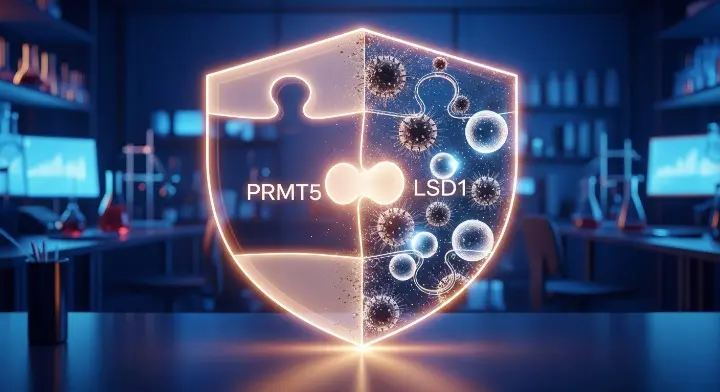
But a groundbreaking study published in Science Advances has revealed a new way to fight back. Researchers have discovered that by using two specific inhibitors together—PRMT5 and LSD1—they can create a “synergistic” effect. In plain English? They’ve found a way to deliver a knockout blow that neither drug could achieve on its own.
The Problem: The “Broken Blueprint”
To understand how this works, imagine your DNA is a massive library of blueprints. In a healthy person, the body knows which books to read to build healthy blood cells. In a person with AML, the “cancerous” books are stuck open, and the “healthy” books are glued shut.
The enzymes PRMT5 and LSD1 are the “librarians” responsible for this mess. They keep the cancer cells in a primitive, aggressive state, preventing them from maturing into normal, functional blood cells.
The Solution: The Double-Key Strategy
Until now, scientists tried attacking these “librarians” one at a time. The results were okay, but the cancer often found a way around the treatment. This new research proves that when you attack both at once:
-
The PRMT5 Inhibitor strips away the cancer’s protective shield, making it vulnerable.
-
The LSD1 Inhibitor then reaches in and “unsticks” the genetic blueprints, forcing the cancer cell to finally grow up and become a normal cell—or simply die.
It’s like a double-key system on a high-security vault. You need both keys turned at the same time to get inside. When these two drugs work together, they don’t just kill the cancer; they reprogram it.
Why This Changes Everything for Patients
The impact of this research on real people cannot be overstated. Here is how it changes the landscape of medicine:
-
Targeting the “Untouchables”: This treatment specifically targets the leukemia stem cells that chemotherapy often misses. This could mean significantly lower relapse rates for patients.
-
Reduced Toxicity: Because these drugs are “targeted,” they act like a sniper rather than a grenade. This means we can potentially achieve better results with lower doses, sparing the patient from the brutal side effects of full-body chemotherapy.
-
A New Path for “Uncurable” Cases: For patients who have stopped responding to standard treatments, this synergistic duo offers a completely new mechanism of action—a fresh hope when other doors have closed.
Looking Ahead: The Future of Blood Health
This study is more than just a discovery about AML; it’s a proof of concept for the future of medicine. It shows that the future of cancer treatment isn’t just about finding one “miracle drug,” but about finding the right combinations of molecules that talk to each other.
We are moving away from a world where we poison the body to save it, and toward a world where we use molecular precision to gently guide our cells back to health. For those battling AML, the “Double-Key” strategy might just be the breakthrough that lets them unlock a future free of cancer.