Scientists found a “hidden code” in our DNA that builds the most powerful computer on Earth: your neocortex

For millions of years, the vertebrate brain was a relatively simple, single-layered affair. If you look at a modern reptile or bird, their “thinking” center—the dorsal pallium—is a straightforward arrangement of neurons. But then, an evolutionary miracle occurred. In the ancestors of mammals, this simple sheet of cells exploded into the six-layered neocortex, a complex biological skyscraper that allows us to reason, create art, and imagine the future.
Until now, the “how” behind this transformation was a biological mystery. But a revolutionary study published in the journal Nature by researchers at the Yale School of Medicine has finally identified the genetic “master architect” responsible for the mammalian brain’s unique architecture.
The Methodology: A Cross-Species Deep Dive
To find the secret sauce of the mammalian brain, scientists led by Dr. Nenad Sestan compared the genetic landscapes of mice, chickens, and reptiles. They didn’t just look at the genes themselves; they looked at the Cis-Regulatory Elements (CREs)—the “dimmer switches” in our DNA that tell genes when to turn on and how brightly to shine.
By using high-tech tools like RNA-Seq and ChIP-Seq, the team mapped out which switches were active in the developing brains of mammals versus non-mammals. They specifically looked at Excitatory Projection Neurons (ExNs)—the primary messengers of the brain—to see how they evolved to create the complex “long-distance” wiring seen only in mammals.
The Shock Factor: The ZBTB18 “Reversion”
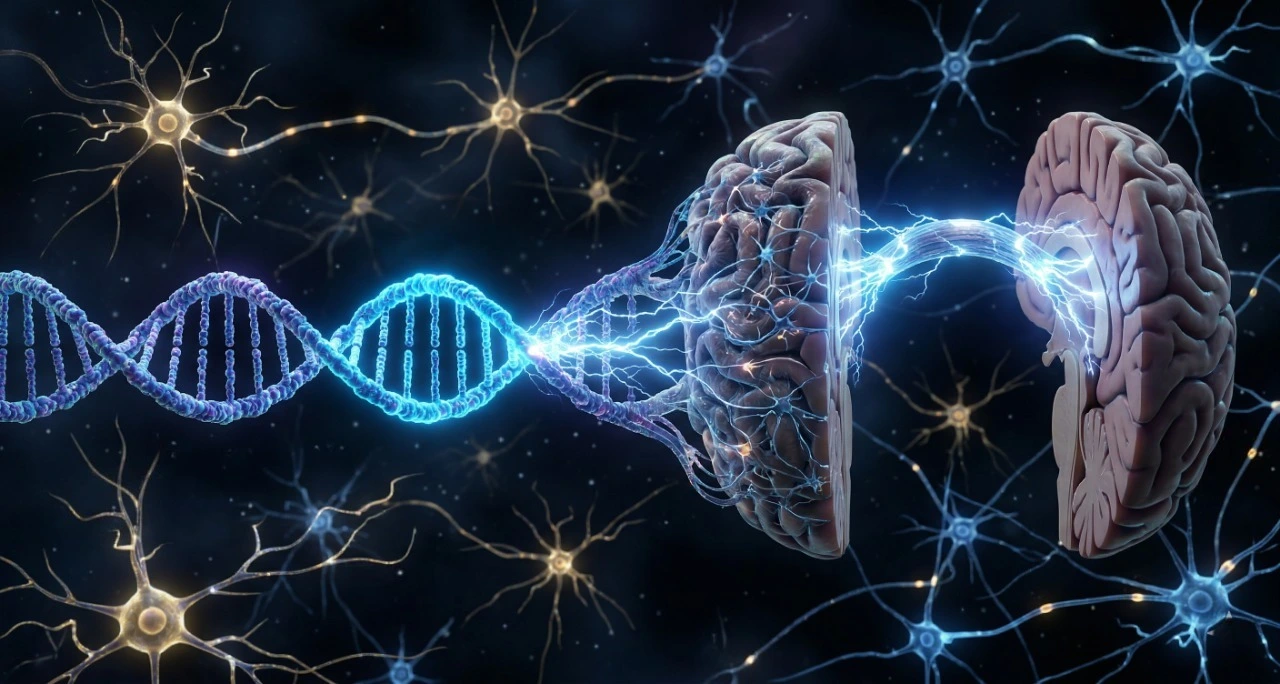
The researchers discovered a mammalian-specific “regulatory node” centered around a protein called ZBTB18. This protein acts like a conductor, orchestrating a massive network of genes that build two critical features of our brains:
-
The Corpus Callosum: The massive bridge that lets the left and right sides of your brain talk to each other.
-
The Corticospinal Tract: The high-speed data cable that connects your brain directly to your spinal cord for precise movement.
The “Shock Factor” came when scientists deleted this ZBTB18 switch in mice. Without it, the mice didn’t just have “brain damage”—their brains actually reverted to an ancestral, non-mammalian state. The sophisticated long-distance wiring vanished, replaced by short-range, local connections. In essence, by removing one genetic switch, they “rewound” the evolutionary clock of the brain by hundreds of millions of years.
Even more startling, the study found that this same ZBTB18 node is frequently mutated in humans with autism and intellectual disabilities, suggesting that these conditions may be linked to a disruption in the very genetic program that makes us “mammalian.”
The Science: Why the Neocortex Wins
In a reptilian brain, neurons are mostly “generalists.” In the mammalian neocortex, ZBTB18 allows for extreme specialization. It creates “Intratelencephalic” (IT) neurons that handle internal communication and “Extratelencephalic” (ET) neurons that send commands to the rest of the body. This division of labor is what gives mammals their superior adaptability and cognitive processing power.
The Life-Change Angle: Unlocking the Neuro-Future
This isn’t just about fossils and history; it’s about the future of human health. Understanding the ZBTB18 node changes how we view the brain in several ways:
-
Targeted Therapies for Neurodiversity: By identifying this “evolutionary node,” researchers now have a specific target for treating neurodevelopmental disorders. If we know how the brain is supposed to wire itself, we can develop therapies to help “re-sync” connections in individuals with autism or learning disabilities.
-
The “Brain Training” Reality: While you can’t change your ZBTB18 gene, you can influence the plasticity it created. The mammalian brain’s greatest strength is its “long-distance” connectivity. Engaging in activities that require cross-hemispheric communication—like learning a musical instrument, a new language, or complex physical coordination—strengthens the very “mammalian” bridges this research describes.
-
A New Respect for Connectivity: We often focus on “brain power,” but this study shows that wiring is what truly matters. Tomorrow, prioritize “deep work” and focus-based tasks; they utilize the specific long-range circuits that took 200 million years of evolution to build.
We are not just “smart animals.” We are the beneficiaries of a highly specific genetic upgrade that turned a simple sheet of neurons into a multi-layered masterpiece.