One of physics’ oldest unsolved problems is why time exists at all. A new experiment built a universe small enough to fit in a laboratory and found the first experimental answer

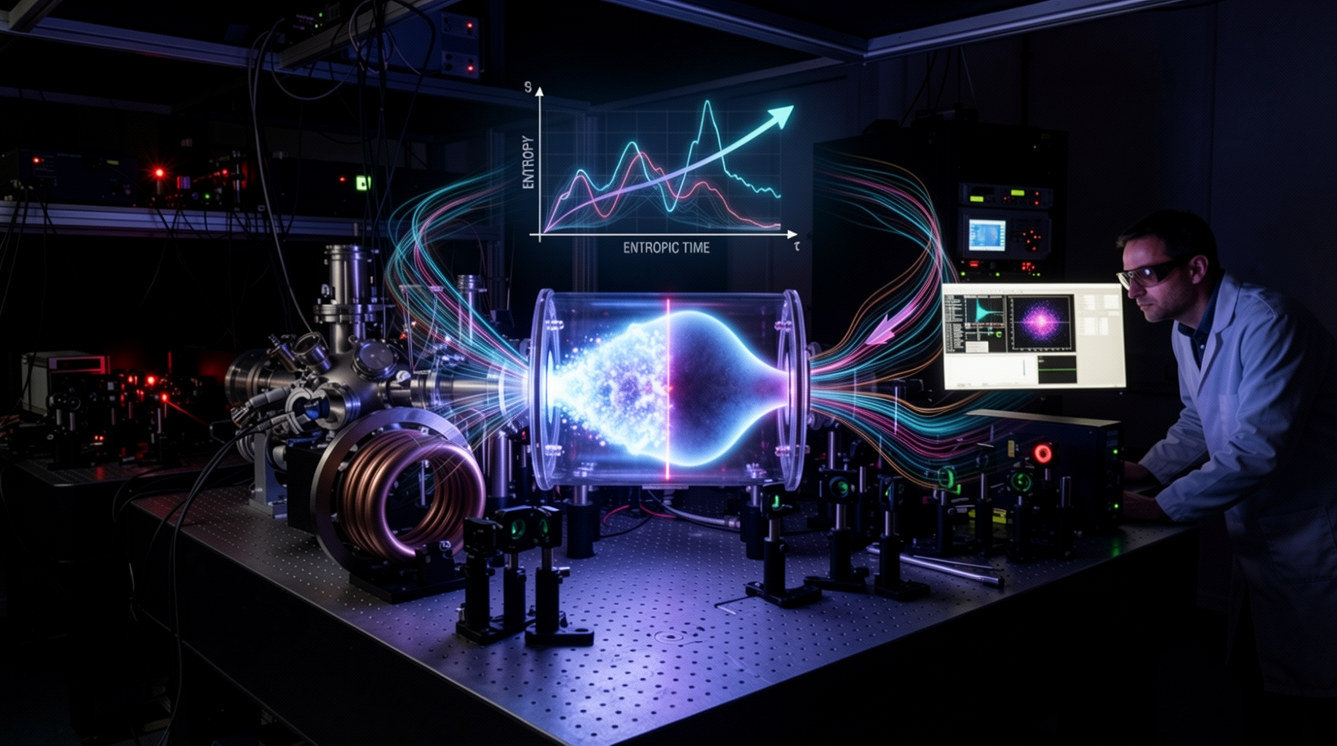
A physicist built a miniature universe in his laboratory, let it expand and collapse like a tiny Big Bang, and showed that time did not exist in it until things started changing
Time is the one thing in physics that everyone experiences and almost no one can explain. You feel it passing. You know it moves in one direction. You know that the past is fixed and the future is open. And if you ask a physicist why any of that is true, they will eventually arrive at a problem that has been sitting at the center of theoretical physics for more than half a century: the equations that describe the universe at its most fundamental level do not contain time.
This is not a philosophical puzzle. It is a mathematical one. The Wheeler-DeWitt equation, which attempts to describe the universe as a complete quantum system, treats the cosmos as a single unchanging state. There is no clock variable in the equation. There is no external timekeeper measuring the universe’s evolution from the outside. If the equation is correct, time as we experience it is not built into the fabric of reality. It emerges from something else entirely, from relationships between the parts of a system, from change itself.
For decades this idea has been theoretical. A physicist at the University of Birmingham has now tested it in a laboratory, using 24,000 ultracold atoms as a miniature universe, and found the first controlled experimental evidence that time can emerge exactly the way the theory predicts.
The miniature universe
The experiment, published in Physical Review Research, was built around a cloud of rubidium atoms cooled to just a few billionths of a degree above absolute zero. At this temperature, the atoms enter a state called a Bose-Einstein condensate, in which quantum effects dominate and the entire cloud behaves as a single coherent quantum object. Professor Giovanni Barontini sealed this cloud inside an isolated system and divided it into two regions using a thin barrier created by two laser beams of different frequencies.
One region was designated the observed or “bright” sector. The other was the unobserved or “dark” sector. The barrier height could be adjusted to control how freely atoms could flow between them. The system was sealed from the outside world, receiving no external signals, no laboratory time stamps, and no information from any conventional clock.
Inside this miniature universe, Barontini let the atoms run. As the barrier height changed, atoms flooded from the dark sector into the bright one in what he describes as a “Big Bang”: a sudden expansion of matter into the observed region. The condensate then reached a maximum and contracted back in what he calls a “Big Crunch.” The entire cycle lasted 120 milliseconds, with snapshots taken every two milliseconds and the experiment repeated at multiple barrier heights.
The question was whether the sequence of events inside the miniature universe could be reconstructed using only information from within the system itself, without any reference to the external laboratory clock.
What time looks like without a clock
The answer Barontini found is that it can, but the clock that makes it possible is not the kind we use in daily life. It is entropy.
Entropy is a measure of disorder, of how spread out and mixed up a system’s components are. When atoms were moving from the dark sector into the bright one, entropy was increasing: the distribution was changing, becoming more spread across the observed region. When atoms moved back, entropy was decreasing locally. And when nothing was moving and the distribution was stable, entropy was constant.
Barontini found that changes in this entropic quantity could define a direction and a sequence for all the events in the miniature universe. He called this “entropic time.” When entropy was changing, the system was moving forward in time. When entropy stopped changing, time effectively stopped. The events inside the mini universe could be correctly ordered, from Big Bang through maximum expansion to Big Crunch, using only this internal measure, with no external reference needed.
“This study provides the first controlled experimental evidence that ‘time’ can be defined by changes within a system rather than as the external ‘ticking clock’ we think of as time,” Barontini said. “It offers new insight into the nature of time in quantum gravity that could be used to describe dynamics just as effectively as conventional time.”
Time that flows in a direction, speeds up, and slows down
The entropic time Barontini measured had three properties that make it a credible candidate for a physical account of time rather than merely a mathematical convenience.
First, it flowed in one consistent direction. The second law of thermodynamics holds that entropy tends to increase in isolated systems over time, and this tendency gives time its arrow: the reason the past is different from the future, the reason you cannot un-stir cream from coffee or un-break an egg. In the miniature universe, entropic time inherited this directionality naturally, without it being imposed from outside.
Second, it correctly ordered events. Throughout the expansion and contraction cycles of the mini universe, entropic time placed each event in the right sequence relative to every other event. The Big Bang came before maximum expansion. Maximum expansion came before the Big Crunch. The internal clock did not lose track or invert the sequence.
Third, it was not uniform. Depending on how entropy was being redistributed at any given moment, entropic time could speed up or slow down. When atoms were moving rapidly and entropy was changing quickly, time ran faster. When the system was near equilibrium and entropy was nearly static, time slowed nearly to a halt. This variability is not a bug in the measurement. It may reflect something real about how time relates to the rate of physical change, a relationship that philosophers and physicists have debated for centuries.
Testing the Schrödinger equation with entropic time
The practical test of whether entropic time is genuinely useful as a physical description of time rather than an ad hoc construct is whether the standard equations of quantum mechanics still work when expressed in terms of it. Barontini showed that they do. He derived an effective version of the Schrödinger equation, the central equation of quantum mechanics that describes how a quantum system evolves, parameterized by entropic time rather than laboratory time. This version of the equation successfully reproduced the measured evolution of the miniature universe.
This result matters because it connects the experiment to the broader problem of quantum gravity. One of the central challenges in building a theory that unifies quantum mechanics and general relativity is that quantum mechanics needs a time variable to describe evolution, while general relativity treats time as something that spacetime geometry defines locally rather than as a universal background. If time can emerge from entropy without needing an external clock, there may be a path toward writing the equations of quantum mechanics in a form that does not assume a fixed time background, which is precisely what a theory of quantum gravity would require.
What the experiment does not prove
Barontini is a sole author at a single institution, and the paper explicitly notes that the findings will require independent replication and broader theoretical scrutiny. The miniature universe is a radical simplification of the actual universe, containing 24,000 atoms arranged in two regions rather than the incomprehensibly complex many-body system that is the cosmos. Whether the same entropic time construction would work in a system orders of magnitude more complex is an open question.
The experiment also does not resolve the philosophical question of whether time is real or merely a useful description. What it does establish is that a particular mathematical construction of time, one that requires no external clock and relies only on internal entropy changes, can be built in a laboratory system and can order events correctly within that system. The idea that was once confined to equations describing the entire universe can now be tested under controlled conditions in a room in Birmingham.
The next steps the researchers identify include expanding the approach to more complex quantum systems and eventually using similar experimental platforms to investigate questions related to the physics of the Big Bang, simulated black holes, and the competing theories of how time, and perhaps the universe itself, began.
The miniature universe expanded, reached its limit, and collapsed back into darkness in 120 milliseconds. In that time, without any clock from the outside world telling it what to do, it produced its own version of before and after. Whether that is time in the fullest sense of the word remains a question for physics to answer. What the experiment established is that something worth calling time can emerge from nothing more than the way things change.
Source
Giovanni Barontini. “Testing the problem of time with cold atoms.” Physical Review Research, 8, L022047, June 11, 2026.
DOI: 10.1103/1h9j-df4k