New research shows “living drugs” can delete three incurable autoimmune diseases at once

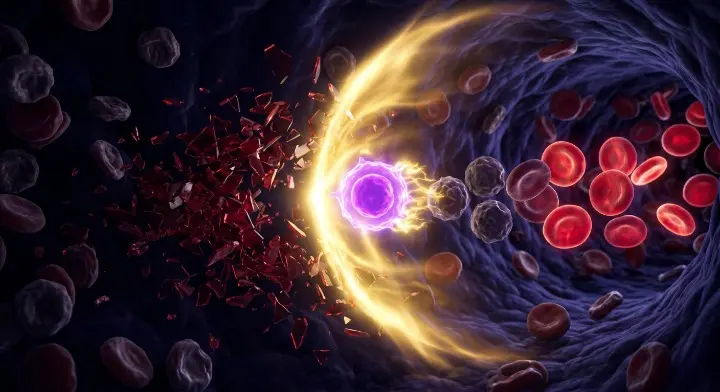
Imagine living in a body that has declared war on itself. For one 47-year-old woman in Germany, this wasn’t a metaphor—it was a daily, life-threatening reality. Since 2014, her immune system had been methodically dismantling her own blood. She suffered from a triad of terrors: Autoimmune Hemolytic Anemia (AIHA), where her body shredded its own red blood cells; Immune Thrombocytopenia (ITP), which tanked her platelet counts; and Antiphospholipid Syndrome (APLAS), which turned her blood into a minefield of potential clots.
By the time she reached the University Hospital of Erlangen, she was trapped in a “transfusion cycle”. Her hemoglobin was so low that she required at least one red blood cell concentrate every single day just to stay alive. She had failed nine different lines of traditional therapy, including high-dose steroids and the “gold standard” B cell-depleting drug, rituximab. Her doctors were out of options. She wasn’t just sick; she was biologically bankrupt.
But in a case report recently published in the journal Med, scientists describe how they used a “living drug” to perform the ultimate factory reset on her immune syste. They didn’t just treat the symptoms. They deleted the problem.
The Problem With “Old” B Cells
The villains in this story are B cells. In a healthy body, these cells are the librarians of your immunity, holding the blueprints for antibodies that fight off viruses and bacteria. In this patient, the B cells had become radicalized. They were producing “autoantibodies”—biological hit contracts that told the rest of the immune system to attack her own blood.
For years, doctors used rituximab to try and wipe these cells out. The problem is that rituximab is like a surface-level cleaner; it misses the “deep” B cells hiding in the bone marrow and tissues. The patient’s “memory” B cells kept surviving the treatment, waking up, and resuming the civil war.
To fix this, the team at Erlangen turned to CD19-directed CAR-T cell therapy, a treatment usually reserved for terminal blood cancers. They took the patient’s own T-cells—the “soldiers” of the immune system—and re-coded them in a lab with a new GPS. This GPS, called a Chimeric Antigen Receptor (CAR), was hard-wired to find and kill every single cell carrying a specific protein called CD19.
Unlike a drug that washes through the system, these CAR-T cells are alive. They hunt. They multiply. And they don’t stop until the target is gone.
Seven Days to Independence
The infusion happened on a day the doctors called “Day 0”. The patient received one million of these re-engineered cells per kilogram of her body weight. The medical team watched her like hawks, waiting for the dreaded “cytokine storm”—a common, violent reaction where the immune system overreacts to the treatment.
It never came.
Instead, something quiet and miraculous began to happen in her blood. By Day 7, the woman who had needed daily blood transfusions for years suddenly didn’t need one. Her body was no longer shredding its own cells faster than the doctors could replace them. By Day 25, her hemoglobin levels—the measure of oxygen-carrying capacity in the blood—hit 13.0 g/dL. For the first time in over a decade, her blood was normal.
The researchers call this a “deep reset”. The CAR-T cells didn’t just lower the count of bad B cells; they effectively “cleared the hard drive” of her entire B cell system. When her B cells finally started to grow back nearly a year later, they weren’t the “war-torn” cells from before. They were 98% “naive”—brand new cells that had no memory of the old autoimmune war.
A Three-for-One Miracle
What makes this case a landmark in hematology is that the treatment didn’t just fix the anemia. It simultaneously stabilized her ITP and caused her dangerous APLAS antibodies to completely vanish.
Think about that: three distinct, chronic, life-threatening autoimmune conditions resolved by a single infusion of programmed cells. The patient experienced a “rapid and remarkable increase in physical strength”. She went from a hospital bed and daily needles to carrying out normal everyday activities.
The “So What?” factor here is massive. While this was a single-patient study, it adds to a growing mountain of evidence that we are entering an era of “cell-based surgery”. We are moving away from taking pills for the rest of our lives to suppress a broken immune system. Instead, we are learning how to re-program that system to fix itself.
The Future of Immune Rebooting
Is there a catch? The treatment isn’t a walk in the park. The patient did experience some lingering liver and bone marrow toxicity, likely due to years of iron overload from all those previous transfusions. Her doctors argue that if we could offer this therapy earlier in the disease course, we could prevent that kind of organ damage altogether.
We still need larger, controlled clinical trials before this becomes a standard option for everyone with an autoimmune condition. But for the millions of people living with diseases like lupus, sclerosis, or severe anemia, the message from Erlangen is clear: your immune system isn’t “broken” beyond repair. It just needs the right update.
The era of the “living drug” has arrived, and it is proving that even the most stubborn biological wars can be ended with the right code.