A decade of research on thousands of people proves that human brains literally synchronize during face-to-face conversation, and lonely brains cannot do it

When two people click, something changes between them. Conversations flow. Silences feel comfortable rather than awkward. Both people later describe the exchange as easy, natural, meaningful. For most of human history this was understood as chemistry, personality, luck. A decade of neuroscience research now suggests it is something more literal: a measurable physical event happening inside two skulls simultaneously, one that can be tracked in real time, predicted before it happens, and deliberately engineered.
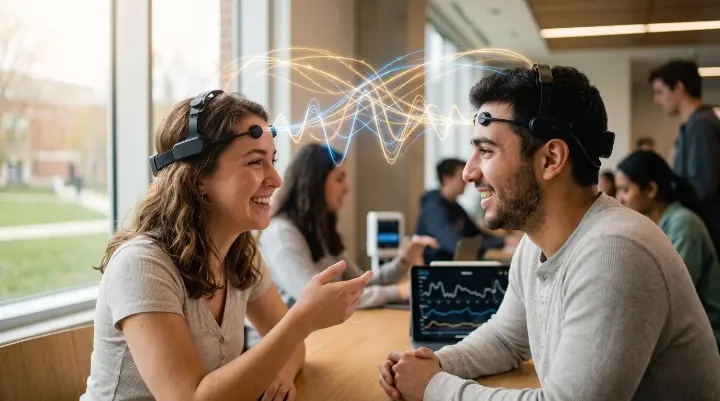
A research team led by Suzanne Dikker of New York University and Ghent University has spent ten years strapping portable electroencephalogram headsets onto high school students, museum visitors, festival crowds, and musicians, recording their brainwave patterns during natural face-to-face interaction. The findings, published in Trends in Cognitive Sciences, document what they call social synchrony: the moment-by-moment alignment of brain rhythms between people engaged in genuine communication. When synchrony is high, people report liking each other more, learning better, and feeling less alone. When it is absent, the neural signature is distinctive. And the researchers have now found they can tip the balance deliberately.
What the brain actually does when two people connect
For most of its history, brain science was trapped inside stationary machines. An fMRI scanner weighs several tons and requires the subject to lie perfectly still inside a narrow tube. Studying what happens between two human brains during a real conversation, in a real room, was technically impossible.
The portable EEG headset changed that. Lightweight enough to wear during a school lecture or a live concert, the device reads electrical activity from the brain’s surface through sensors pressed against the scalp. It cannot resolve the fine anatomical detail of an fMRI scan, but it captures something the fMRI cannot: brainwaves in motion, in context, across two or more people at once.
Dikker’s team deployed these headsets in environments that neuroscience laboratories had never previously accessed. They recorded high school students during weeks of classroom instruction. They tracked museum visitors moving through exhibits together. They wired festival attendees and watched what happened to their neural patterns as they listened to live performances alongside strangers. And in 2019, they fitted portable EEGs onto Bad Bunny and Residente as the two artists collaborated on the track “Bellacoso,” displaying the real-time state of their neural alignment on screens in the studio so the musicians could watch their own brains sync and experiment with different approaches to creative collaboration.
Across all of these settings, the pattern that emerged was consistent. When people were genuinely engaged with one another, their brainwave rhythms began to match. The alignment was not metaphorical. The electrical oscillations in one person’s brain began to mirror the timing of the oscillations in another person’s brain, measured in milliseconds, visible in the raw data.
Classrooms, loneliness, and the neural cost of isolation
The high school studies produced the clearest practical results. Over the course of weeks, the team measured brainwave synchrony between individual students and tracked it against social and academic outcomes. Students whose neural patterns synchronized more strongly with their classmates reported liking those classmates more. They also reported greater engagement with the course material and rated the class itself more positively.
The causal direction here is difficult to establish definitively. Students who already liked each other might synchronize more easily. But the correlation held even when controlling for prior relationships, suggesting that synchrony itself carries information about the quality of an interaction, not just a reflection of who already gets along.
The loneliness findings were more striking. When the researchers looked at the brainwave data from socially isolated individuals, they found a distinctive pattern: their neural activity during interactions was more idiosyncratic, more unique to them, less willing to fall into alignment with the people around them. Lonely brains, in a measurable sense, struggle to synchronize. Whether isolation causes the idiosyncratic neural pattern or the idiosyncratic pattern makes synchrony harder to achieve remains an open question. But the researchers argue that the relationship is almost certainly bidirectional, and that the neural signature of loneliness they have identified is not just a symptom but possibly a mechanism.
“Lonely individuals show more idiosyncratic brain activity, and there is growing evidence suggesting that face-to-face activities that involve interpersonal synchrony, such as playing games or engaging in everyday banter, is important to maintaining social cohesion in communities,” said Dikker.
The phrase “everyday banter” is not incidental. The team emphasizes throughout their analysis that the activities most reliably associated with brainwave synchrony are not structured or mediated. They are casual: sitting together, playing a game, talking about nothing in particular, watching something live. Screen-mediated interaction, even video calls, does not produce the same degree of neural alignment as physical co-presence. The body of research treats face-to-face contact not as a preference but as a biological requirement for the kind of synchrony that supports social health.
Engineering the connection
The most significant implication of ten years of measurement is the possibility it opens in the opposite direction: instead of just observing synchrony, producing it.
The paper published in Trends in Cognitive Sciences introduces what the team calls multi-brain neurofeedback, a framework in which the real-time state of brainwave alignment between two people is fed back to them visually or audibly, allowing them to adjust their behavior to increase it. In the studio experiment with Bad Bunny and Residente, the artists could see their synchrony scores shifting as they tried different approaches to collaboration. They were, in effect, using their own neural data as an instrument.
The clinical application the researchers are now developing extends this idea into therapy. Under a four-million dollar grant from ARPA-H, the federal agency tasked with funding high-risk, high-reward health research, Dikker and colleagues at the University of California San Diego will run clinical trials in which brainwave synchrony between therapists and patients is measured and fed back in real time during sessions. The hypothesis is that by helping both parties see when synchrony is high and when it collapses, they can learn to maintain the neural alignment that predicts therapeutic rapport. Building that rapport currently takes months in conventional talk therapy. The researchers believe that neurofeedback-assisted sessions could compress that timeline substantially.
The target conditions are deliberately ambitious. Treatment-resistant depression, which fails to respond to standard antidepressants in roughly a third of patients. PTSD, where the therapeutic relationship is frequently disrupted by the very symptoms the therapy is attempting to treat. And chronic loneliness, which the researchers characterize not as a social preference but as a neurobiological state with measurable effects on brain function and long-term health outcomes comparable to smoking.
What this changes about how we understand connection
The framework the researchers have built over ten years does not claim that social connection is reducible to brainwave alignment. Dikker is careful to describe synchrony as a marker and a mechanism, not a complete explanation. Two people can be neurally synchronized and still have a shallow relationship. Two people can have a deep relationship and show variable synchrony depending on what they are doing and what state they are in.
What the research does establish is that something real and measurable happens in the brain during genuine human connection, that this measurable event can be distinguished from its absence, and that it matters for outcomes that extend well beyond the interaction itself. Students learn better when it happens. People feel less lonely when it happens. And now there is a clinical hypothesis with federal funding behind it suggesting that deliberately inducing it could help the roughly one in three adults in the United States who report feeling chronically isolated.
The next step is clinical trials. If they show what the researchers expect, the phrase “being on the same wavelength” will have completed a journey that most idioms never make: from figure of speech to biological fact to medical treatment.
Source
Yafeng Pan, Xiaojun Cheng, Guillaume Dumas, Suzanne Dikker. “Multi-brain neurofeedback: what are we training for?” Trends in Cognitive Sciences, 2026.
DOI: 10.1016/j.tics.2026.05.007