New research shows how external trauma and internal anxiety converge to trigger permanent hair loss
We have always known intuitively that stress makes our hair fall out. From the “mad professor” tropes to the very real thinning people experience after a personal tragedy, the link is undeniable. But until now, the biological “bridge” between a stressful event and a dying hair follicle remained a mystery.
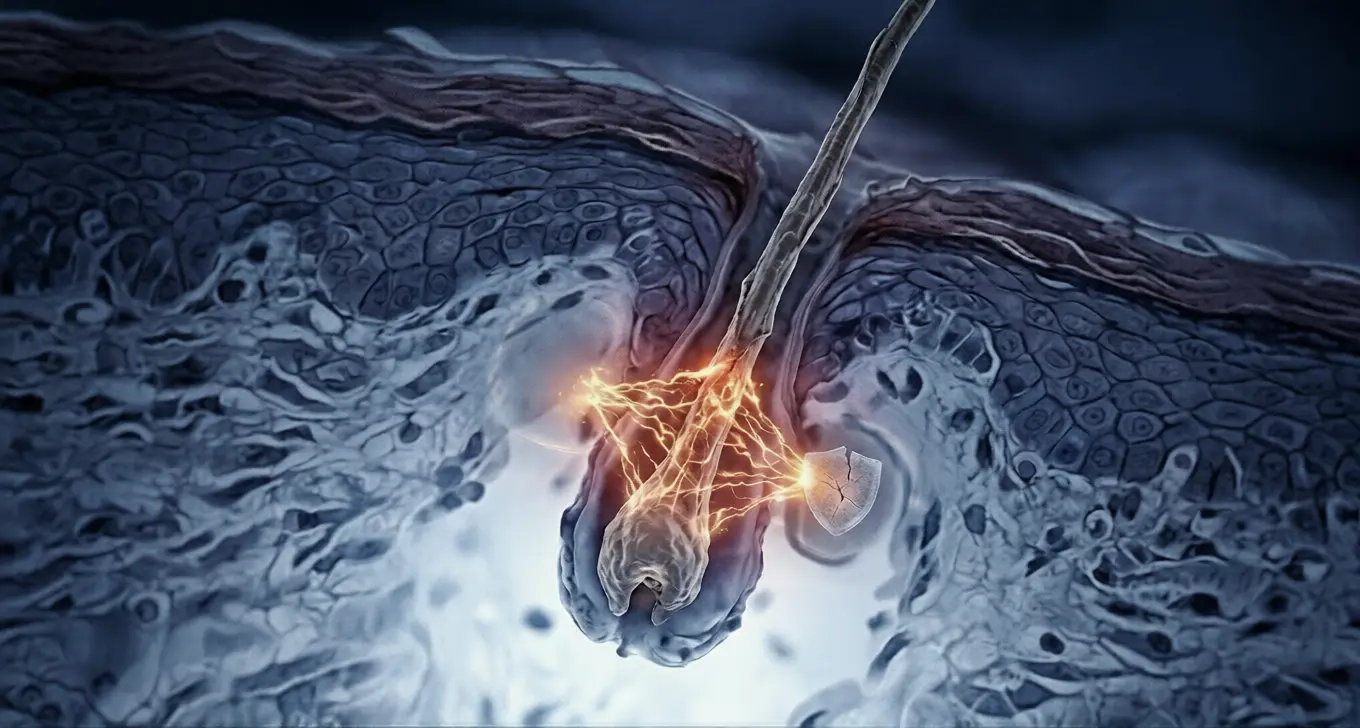
A monumental study published in PNAS (Proceedings of the National Academy of Sciences) has finally identified the molecular ground zero. Researchers have discovered a specific genetic enhancer of the Sonic hedgehog (Shh) gene that acts as a lightning rod for both environmental and psychological stress.
The Discovery: The Shh Enhancer
The Sonic hedgehog gene is not just a quirky name; it is one of the most critical pathways in human development, responsible for everything from limb growth to the regeneration of hair follicles. The study found that this gene doesn’t just “fail”—it is actively suppressed by a specific regulatory element (an enhancer) that reacts to stress signals.
Researchers found that when the body is under pressure, it produces specific hormones and chemical signals that “converge” on this DNA enhancer. This convergence acts like a dimmer switch, turning down the production of the Shh protein. Without enough Shh, hair follicles lose their ability to enter the growth phase, leading to disorders like alopecia and chronic thinning.
The Shock Factor: The “Double-Threat” Convergence
The most startling revelation from the research is that the Shh enhancer doesn’t distinguish between types of stress.
-
External Stressors: Environmental toxins, UV radiation, and physical trauma.
-
Internal Stressors: Cortisol spikes from anxiety, sleep deprivation, and emotional grief.
The “Convergence” Effect: Scientists found that if you are under high internal stress, your hair follicles become significantly more vulnerable to external damage. It is a cumulative “double-hit” model. The enhancer collects these signals until a threshold is reached, at which point it shuts down hair production. This explains why some people can handle toxic environments or high stress individually, but lose their hair when both occur simultaneously.
The “Life-Change” Angle: Protecting Your Follicles
This discovery moves hair loss treatment away from “cosmetic fixes” and toward “genetic protection.” By identifying the specific enhancer responsible for the shutdown, science has provided a target for future preventative care.
How this changes your approach to hair health:
-
The Threshold Awareness: Understand that your hair has a “stress budget.” If you are going through a high-stress period at work (internal), you must be hyper-vigilant about protecting your scalp from UV rays and harsh pollutants (external) to prevent reaching the genetic breaking point.
-
Targeted Topicals: The study opens the door for new “Shh-activator” treatments. Instead of generic minoxidil, future therapies may specifically target the Sonic hedgehog pathway to keep the “growth switch” flipped to the ON position, even during stressful life events.
-
Holistic Defense: Since the Shh enhancer is the point of convergence, “stress management” is no longer just “wellness advice”—it is a clinically proven method for maintaining the integrity of your genetic hair-growth signals.
By pinpointing the exact genetic coordinate where stress meets biology, this research transforms our understanding of hair disorders from a mystery of “bad luck” into a manageable biological process.