Scientists found that your brain, heart, and lungs can each be aging at completely different speeds, and a single blood test can now tell you which one is aging fastest

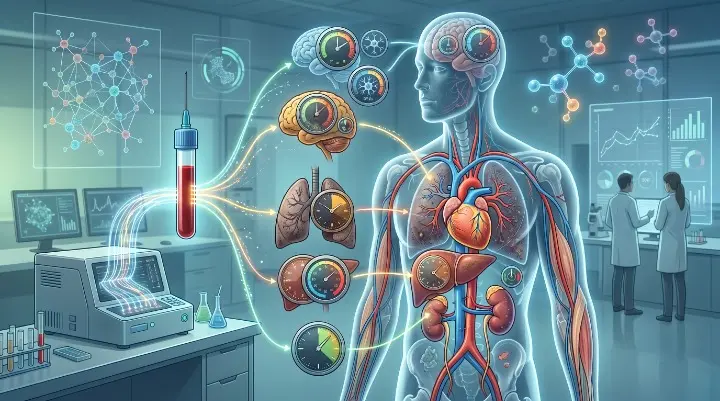
You don’t have one biological age. You have dozens, one for nearly every tissue type in your body, and they can be wildly different from each other and from the number on your driver’s license. A study published in Nature Medicine on June 15 by Tony Wyss-Coray’s lab at Stanford, using a single blood draw analyzed for over 7,000 proteins across more than 60,000 people, found that the biological age of your heart, your brain’s immune cells, your lungs, and dozens of other tissue types can each be tracked separately, and that a handful of people are aging dramatically faster in one specific organ while the rest of their body ages normally.
About 20 to 25 percent of people in the study showed accelerated aging concentrated in a single cell type, essentially one organ system quietly running years ahead of the rest of the body. A smaller group, 1 to 3 percent, showed accelerated aging across ten or more cell types simultaneously, a pattern that predicted significantly worse health outcomes overall.
How you measure 40 different ages from one blood sample
The technique builds on earlier work from the same lab showing that plasma, the liquid component of blood, carries proteins released by virtually every organ in the body. Each organ and cell type sheds a slightly different protein signature into the bloodstream as it functions and as it ages. The Stanford team trained machine learning models to read those signatures and estimate a separate biological age for more than 40 distinct cell types, spanning neurons, immune cells, glial cells in the brain, hormone-producing cells, the lining of organs, and musculoskeletal tissue.
This is a meaningfully different approach than earlier biological age tests, which typically produce one overall number for the whole body. The new models instead ask a more specific question for each tissue type: based on the proteins this cell type is releasing into your blood, is it behaving like it belongs to someone older or younger than you actually are.
What an aging brain immune cell does to your odds of Alzheimer’s
The clearest example in the study involves a gene variant called APOE4, the strongest known genetic risk factor for Alzheimer’s disease. People carrying two copies of APOE4 who also showed extreme aging specifically in their astrocytes, a type of support cell in the brain, had triple the risk of developing Alzheimer’s compared with APOE4 carriers whose astrocytes looked biologically young. The astrocyte aging measurement added meaningful predictive information on top of what the genetic risk alone could tell you.
Strikingly, the same APOE4 carriers tended to have younger-than-expected macrophages, a type of immune cell, while APOE2 carriers, who have a different relationship with Alzheimer’s risk, showed the opposite pattern. The same genetic variant was pulling different cell types in opposite directions, aging some faster and others slower, a level of detail that a single whole-body aging score could never have captured.
The pattern repeated outside the brain
The astrocyte-Alzheimer’s link wasn’t an isolated finding. Smokers whose respiratory-associated cells showed accelerated aging had a 58 percent higher risk of lung cancer compared with smokers whose lung-related cell signatures looked younger. People with normal blood sugar who nonetheless showed accelerated aging in their myeloid immune cells were at higher risk of developing diabetes later, even though a standard blood sugar test on the same day would have shown nothing unusual.
In both cases, the disease risk was hiding in a cell-specific aging signature that a conventional test, a chest X-ray, a fasting glucose check, wouldn’t have caught. The aging signal showed up in the blood before the disease showed up anywhere else.
Why having one old organ matters even if you’re young everywhere else
The researchers tracked outcomes over 15 years of follow-up and found that both specific vulnerabilities and the overall accumulation of aging across cell types independently affected survival. People with youthful-looking immune or neuronal cell signatures, even if other tissues were aging more typically, had a survival advantage. The reverse was also true: concentrated old age in just one or two systems was enough to meaningfully shift someone’s risk profile, even when most of their body looked unremarkable.
The team combined all of this into what they call a polycellular aging risk score, a single number built from the full pattern of cell-specific ages rather than any one tissue alone, and found it reliably stratified mortality risk across multiple independent groups of patients and across different lab platforms used to measure the underlying proteins.
What this changes about how aging gets measured
Most existing biological age tests, the kind sold directly to consumers, return a single number: you are biologically 42 even though you’re chronologically 50, or some version of that framing. This study is a direct challenge to the idea that a single number is the right way to think about your own aging at all. The data suggests that the more clinically useful question isn’t “how old am I overall” but “which of my organs, if any, is aging faster than the rest, and what does that specifically put me at risk for.”
The practical test isn’t available to consumers yet. This is a research finding built on a specific, large-scale dataset and a set of machine learning models trained for the study, not a product you can currently order. But the underlying technology, a standard blood draw analyzed for thousands of proteins, already exists and is used in research settings today. The distance between this finding and a clinically available test that flags, for instance, “your astrocytes are aging unusually fast, talk to your doctor about Alzheimer’s risk monitoring,” is a matter of validation and regulatory approval rather than a missing scientific breakthrough.
Sources:
Ding, D.Y., Bot, V.A., Chen, K.L., Wyss-Coray, T., et al.
Plasma proteomic signatures of cellular aging predict human disease.
Nature Medicine, June 15, 2026.
nature.com/articles/s41591-026-04446-y
nature.com/articles/s41591-026-04447-x (accompanying research briefing)