Scientists discovered that overeating may not be a discipline problem but a broken relay in a brain circuit nobody knew existed until now

Every time you eat past the point of fullness, the explanation you reach for is willpower. You were tired. You were stressed. You lacked discipline. The food was too good. This framing has shaped the entire cultural conversation around obesity and overeating for decades, placing the burden of failure squarely on the individual’s character while leaving the actual biology of appetite almost entirely out of the conversation.
A study published in the Proceedings of the National Academy of Sciences on April 6, 2026 just found a previously unknown brain circuit that controls whether you feel full at all. It involves a type of cell that scientists spent most of the last century dismissing as irrelevant to this process. And it raises a question that the willpower narrative has never been able to answer: what if the signal telling you to stop eating is simply not arriving?
The Cells That Were Supposed to Be Background Noise
The brain contains roughly as many astrocytes as it does neurons. For most of neuroscience’s history, astrocytes were treated as structural support cells, the scaffolding that holds the important cells in place, the janitors that clean up chemical waste, the passive infrastructure of a system where neurons did all the meaningful work. They were named for their star shape and then largely ignored.
The research, led by scientists at the University of Concepción in Chile in collaboration with Ricardo Araneda’s laboratory at the University of Maryland, has now overturned that assumption in one of the most behaviorally significant areas of the brain: the hypothalamus, the region responsible for regulating hunger and fullness. What the team found is that astrocytes in this region are not passive. They are active participants in a communication chain that determines whether the fullness signal reaches the neurons that can actually stop you from eating. Without their involvement, the chain breaks down entirely.
The Three-Step Chain Nobody Knew Existed
The discovery centers on a signaling pathway that had never been mapped before. It works like this.
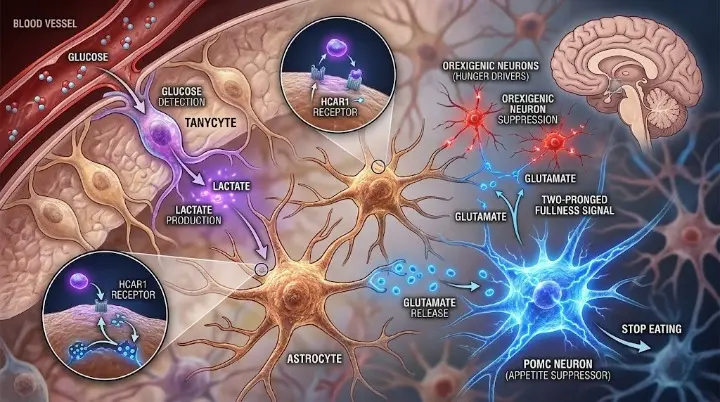
When you eat, blood glucose rises. In the hypothalamus, a specialized type of cell called a tanycyte detects this glucose and processes it, converting it into a metabolic byproduct called lactate. For years, researchers assumed that this lactate traveled directly from tanycytes to the appetite-controlling neurons that suppress hunger, known as POMC neurons, activating the fullness response directly. The textbook version of appetite regulation did not include a middleman.
The University of Maryland and University of Concepción team found the middleman. Astrocytes carry a receptor on their surface called HCAR1 that is specifically designed to detect lactate. When the lactate produced by tanycytes binds to HCAR1, the astrocytes activate and release glutamate, a chemical messenger, into the surrounding tissue. That glutamate then reaches the POMC neurons and increases their excitability, triggering the suppression of appetite and the sensation of fullness.
“To put it simply, we found that tanycytes talk to astrocytes, and then astrocytes talk to neurons,” said Ricardo Araneda, co-senior author of the study. “What surprised us was the complexity of it.” The researchers proved this in a particularly elegant experiment: they introduced glucose into a single tanycyte while monitoring surrounding astrocytes. Even that localized change triggered activity in multiple astrocytes simultaneously, demonstrating how the signal spreads through the network and amplifies before it reaches the neurons that act on it.
Two Brakes Instead of One
The pathway does something even more sophisticated than activating the stop-eating signal. It simultaneously suppresses the start-eating signal from the opposite direction.
POMC neurons are the brain’s appetite suppressors. But they exist alongside orexigenic neurons, cells that drive hunger and motivate continued eating. A meal that simply activates POMC neurons while leaving orexigenic neurons firing at full strength would produce a confused and ineffective fullness signal. The tanycyte-astrocyte pathway hits both simultaneously. Lactate from tanycytes, working through astrocytes, activates the neurons that say stop while also quieting the neurons that say keep going. The brakes come on from two directions at once.
This dual mechanism is why the researchers described it as a two-pronged fullness signal. The architecture is not just telling you to feel full. It is actively dismantling the competing signal that wants you to keep eating. Understanding that this circuit exists, and that astrocytes are the essential relay point through which it works, reframes what it means when the fullness signal fails to arrive.
What Happens When the Switch Stops Working
The circuit the researchers mapped is elegant and precise under normal physiological conditions. But several factors are known to disrupt it, and many of them are features of how most people in the modern world actually live.
In diet-induced obesity, POMC neurons show measurably reduced excitability. The cells that are supposed to receive the stop-eating signal become progressively less responsive to it. Research has shown that high-fat feeding causes defective regulation of these neurons, with inflammatory signals activated by chronic consumption of high-fat diets inducing leptin and insulin resistance in the hypothalamus. The pathway that should be delivering the fullness message is reaching neurons that have been partially numbed to receiving it.
The astrocyte relay itself is also vulnerable to disruption. Astrocytes in the striatum, another brain region involved in behavior and metabolism, have been shown to modulate both behavioral flexibility and whole-body metabolism. When striatal astrocytes are manipulated, metabolic outcomes change significantly. A 2025 study published in Nature Communications found that activating these cells could actually reverse some of the metabolic effects of obesity in mice, restoring cognitive function that obesity had impaired. The implication is that astrocyte dysfunction in the context of obesity is not just a consequence of the condition. It may be actively participating in maintaining it.
The Ozempic Connection
The researchers were explicit about where this discovery points therapeutically. The HCAR1 receptor on astrocytes, the specific molecule that detects lactate and triggers the fullness cascade, represents a novel drug target that has not previously been identified in the context of appetite regulation.
“We now have a different mechanism where we might be able to target astrocytes or specifically this HCAR1 receptor,” Araneda said. “It would be a novel target that may complement existing therapies like Ozempic, for example, and improve the lives of many who suffer from obesity and other appetite-related conditions.”
This framing matters because it positions the astrocyte pathway not as a replacement for existing obesity treatments but as a potential addition to them. GLP-1 receptor agonists like semaglutide work primarily by mimicking a gut hormone that signals to the brain after eating, reducing appetite and slowing gastric emptying. The HCAR1-astrocyte pathway operates at a different point in the signaling chain and through a different cellular mechanism entirely. Targeting both simultaneously could produce a more complete and robust fullness response in people whose appetite regulation has broken down through multiple pathways simultaneously.
The Question This Changes
For decades the dominant public health framing of obesity has centered on individual choices: what people decide to eat, how much they decide to move, whether they have the discipline to resist food that is engineered to override their better judgment. This framing has produced a culture of blame directed at people whose biology is, in many cases, working against them in ways they cannot feel or observe.
The circuit just mapped at the University of Maryland and University of Concepción is one of several emerging findings that collectively paint a different picture. The decision to stop eating is not purely a matter of character. It is the output of a specific, mappable biological system involving glucose sensing, lactate signaling, astrocyte activation, glutamate release, and POMC neuron excitability. When any part of that chain is disrupted, the signal does not arrive. Not because the person chose to ignore it, but because the cell that was supposed to relay it did not fire correctly.
The researchers spent nearly ten years building the experimental foundation for this discovery. What they found is that the brain’s appetite regulation system is more complex, more cellular, and more dependent on cells previously considered irrelevant than anyone had recognized. The astrocyte, the cell that was supposed to be background noise, turns out to be the essential relay in the circuit that tells you to put the fork down. When that relay fails, nothing downstream can compensate for it.
That is not a willpower problem. It is a biology problem. And it now has an address.
Source:
García-Robles, M.A., López, S., Araneda, R., et al. Tanycyte-derived lactate activates astrocytic HCAR1 to modulate glutamatergic signaling and POMC neuron excitability. Proceedings of the National Academy of Sciences, April 6, 2026. DOI: 10.1073/pnas.2537810123 https://www.pnas.org/doi/10.1073/pnas.2537810123