New research reveals that thymus health may be one of the strongest predictors of lifespan, cardiovascular survival, and cancer outcomes ever found

Most people can name their heart, lungs, liver, and kidneys without hesitation. Almost nobody thinks about the thymus. It sits quietly just above the heart, does its most visible work before puberty, and then spends the rest of a person’s life shrinking into a small island of fatty tissue that medicine has largely written off as irrelevant. Two studies published simultaneously in Nature by researchers at Mass General Brigham just made that assumption very difficult to hold.
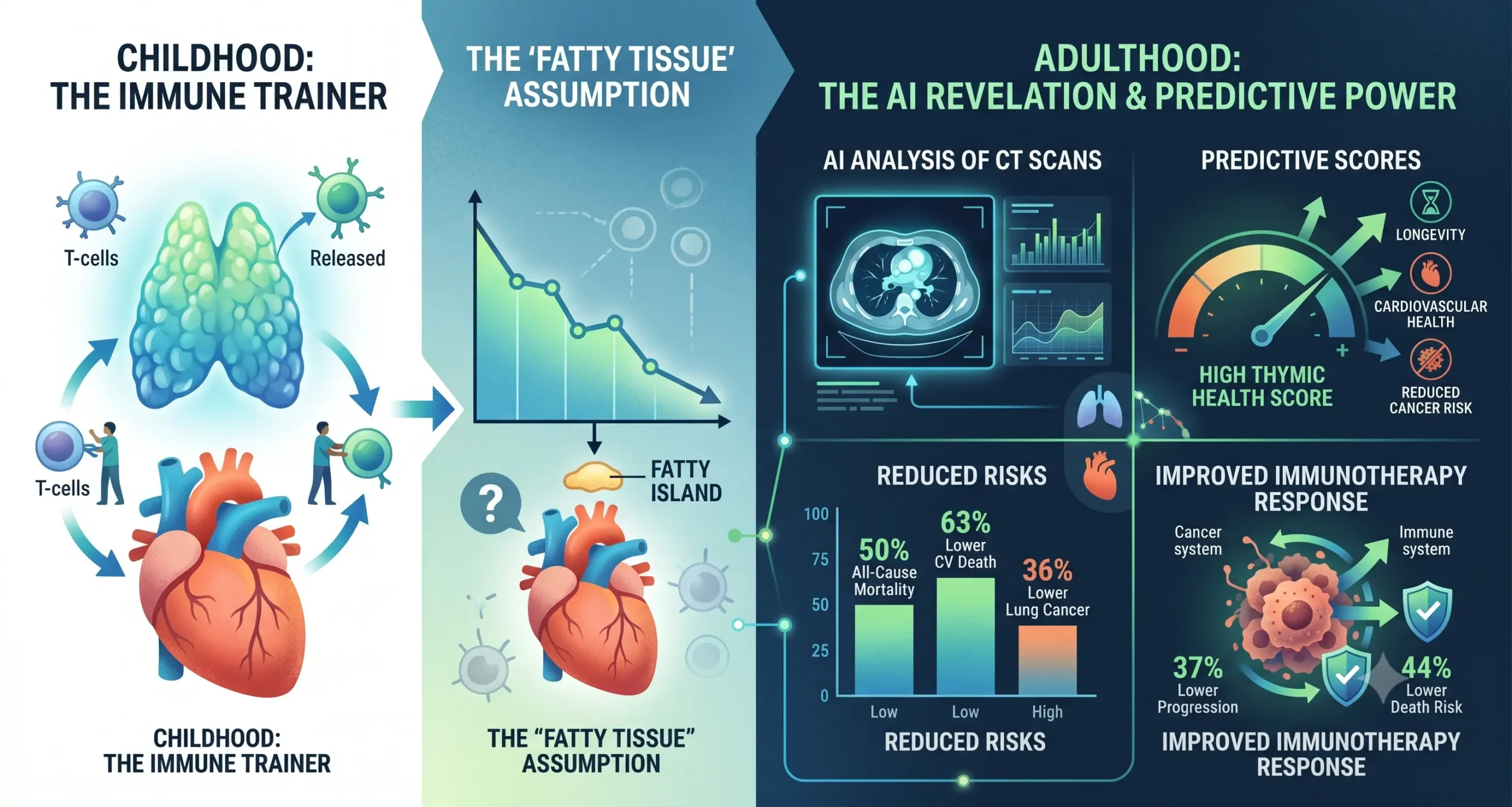
Using artificial intelligence to analyze routine CT scans from more than 25,000 adults, the team found that the health of the thymus in adulthood is one of the strongest predictors of longevity, cardiovascular survival, and cancer risk that imaging has ever revealed. People with the highest thymic health scores had a 50% lower risk of death from any cause, a 63% lower risk of dying from cardiovascular disease, and a 36% lower risk of developing lung cancer compared to those with the lowest scores. A second study extended these findings into cancer treatment, finding that thymic health predicted whether immunotherapy would work, cutting cancer progression risk by 37% and death risk by 44% in patients with stronger thymic function.
The organ medicine stopped paying attention to after childhood turns out to have been quietly determining whether adults live or die for their entire lives.
Why the Thymus Was Abandoned
The thymus has a well-documented early life story. During childhood and adolescence it produces T cells, the immune system’s most sophisticated defenders, training them to distinguish the body’s own tissue from foreign threats and releasing them into circulation to patrol for infection, cancer, and cellular damage. By the time a person reaches their mid-twenties, the thymus has shrunk substantially, replaced in large part by fatty tissue, and produces far fewer new T cells than it did during development.
This observable shrinkage led medicine to a conclusion that seemed logical at the time: the thymus had done its job. The T cells were in circulation, the immune system was established, and the organ that built it had retired. Textbooks reflected this. Medical training reflected this. Routine clinical practice reflected this. Nobody was measuring thymic health in adults because nobody believed there was anything meaningful left to measure.
Two new studies from investigators at Mass General Brigham challenge a decades-old assumption that the thymus, an organ best known for its role in establishing immune function in childhood, becomes irrelevant in adulthood. What the AI analysis revealed is that the thymus does not simply stop functioning after puberty. It continues producing T cells throughout adult life, in quantities and qualities that vary significantly between individuals, and that variation turns out to matter enormously for health outcomes across decades.
How AI Found What Human Eyes Missed
The discovery required a tool that did not exist until recently. The thymus on a CT scan looks like a small region of tissue in the chest, unremarkable to most radiologists reviewing scans for other purposes. Measuring its health precisely enough to generate meaningful predictive data across tens of thousands of patients required a deep learning AI model trained specifically to assess thymic size, structure, and composition and convert those measurements into a standardized thymic health score.
Hugo Aerts, director of the Artificial Intelligence in Medicine program at Mass General Brigham and senior author of both studies, had originally set his team onto the thymus while looking for a way to predict immunotherapy response through CT imaging. T cells could not be directly visualized on scans, but the thymus that produces them could. The AI model his team developed ended up revealing something far larger than an immunotherapy predictor.
People with high thymic health scores had about a 50% lower risk of death, 63% lower risk of cardiovascular death, and 36% lower risk of developing lung cancer compared to those with low thymic health. These associations remained significant after adjusting for age and other health factors.
The dataset behind these numbers was the National Lung Screening Trial, a large federally funded screening program that followed participants over years with repeated imaging and outcome tracking. The Framingham Heart Study, one of the longest-running cardiovascular cohort studies in history, provided a second independent validation dataset. The consistency of the thymic health signal across two completely different populations with different follow-up structures and different primary health endpoints is what gives the findings their weight.
The Immune Diversity Explanation
The biological mechanism behind the association runs through T cell diversity, a concept that has been accumulating evidence in aging research for years but had never been connected to a measurable imaging marker at this scale.
A healthy thymus continuously releases newly trained T cells into circulation throughout adulthood. These fresh T cells carry different receptor configurations than the cells trained earlier in life, expanding the range of threats the immune system can recognize and respond to. As the thymus weakens and its output declines, the immune repertoire narrows. The same T cell populations that have been circulating for decades gradually dominate, and the system loses its capacity to mount effective responses against novel threats including emerging infections, early cancer cells, and the molecular damage that accumulates with age.
The researchers theorize that when thymic health and T cell diversity decline, the immune system may become less able to respond to new threats, like cancer or other diseases. Their analysis found that chronic inflammation, smoking, and high body weight were associated with poorer thymic health, suggesting that lifestyle and systemic inflammation may influence immune resilience across the lifespan.
This pathway helps explain why thymic health predicts cardiovascular death as strongly as it does. Atherosclerosis, the arterial plaque buildup that drives most cardiovascular events, involves an immune component. T cells regulate the inflammatory processes that determine whether plaques stabilize or rupture. A narrower, less diverse immune repertoire produced by a deteriorating thymus may leave the inflammatory dynamics of arterial disease less well controlled, contributing to higher cardiovascular mortality in ways that have nothing to do with cholesterol or blood pressure directly.
The Cancer Treatment Finding
The second study focused on cancer patients receiving immunotherapy, a treatment category that depends entirely on the patient’s own immune system doing the work of eliminating tumor cells after the therapy removes the molecular brakes that were suppressing it.
In a separate analysis of more than 3,400 cancer patients undergoing immunotherapy, patients with stronger thymic health had a 37% lower risk of cancer progression and a 44% lower risk of death, even after accounting for age, tumor type, and other health factors.
This finding carries immediate clinical relevance because immunotherapy response rates vary enormously between patients in ways that oncologists currently cannot reliably predict before starting treatment. Patients with healthy thymuses producing diverse T cell populations have more immune resources available to respond when the treatment removes checkpoint inhibition. Patients with depleted thymic function may simply not have the immune architecture needed to mount the response the therapy is designed to amplify.
The implication is that thymic health assessment before immunotherapy could help oncologists predict which patients are most likely to benefit, allowing for more informed treatment decisions and potentially prompting investigation of thymic support strategies before treatment begins in patients with poor thymic scores.
What the Thymus Can Tell You That Other Tests Cannot
The significance of the Mass General Brigham findings lies not just in what the thymus predicts but in how it predicts it. Most biomarkers of longevity and disease risk capture a single system. Cholesterol measures lipid metabolism. Blood pressure measures cardiovascular strain. Inflammatory markers like CRP measure the current state of the immune response. The thymic health score captures something different: the underlying productive capacity of the immune system across its full range of functions.
“The thymus has been overlooked for decades and may be a missing piece in explaining why people age differently, and why cancer treatments fail in some patients,” Aerts said. The data behind that statement covers more than 25,000 adults, two independent validation cohorts, and outcome tracking across cardiovascular death, all-cause mortality, cancer incidence, and immunotherapy response. That breadth is unusual for a single imaging biomarker.
The CT scans used to generate these measurements are already being taken by millions of people annually for lung cancer screening, cardiovascular assessment, and other clinical purposes. The data has been sitting in those scans for years. The AI model needed to extract thymic health scores from them is built and validated. The clinical infrastructure required to turn this research into routine practice is closer than it might appear.
The Organ That Was Never Truly Retired
The medical consensus that the thymus becomes largely irrelevant after childhood was a reasonable inference from the evidence available at the time it was formed. The thymus does shrink. It does produce fewer T cells with age. These observations were accurate. What they failed to account for is that the thymus’s continuing output, even in its diminished adult state, maintains an immune diversity that quietly determines how well the body manages the full range of threats that accumulate across a lifetime.
The organ medicine stopped watching after puberty has been working ever since, and the condition it has been in has been reflected in every cardiovascular outcome, every cancer diagnosis, and every immunotherapy response outcome that those 25,000 adults experienced in the years after their scans were taken.
It was never irrelevant. Medicine just did not yet have the tools to see what it was doing.
Sources:
Vos, J.L., Galazka, T., Brouwer, T.P., Aerts, H.J.W.L., et al. Thymic health consequences in adults. Nature, 2026. DOI: https://doi.org/10.1038/s41586-026-10242-y
Vos, J.L., et al. Thymic health and immunotherapy outcomes in patients with cancer. Nature, 2026. DOI: 10.1038/s41586-026-08943-5