Teens who spend 6 hours a day on social media are twice as likely to develop anxiety. A new study found their risk of suicidal thoughts triples

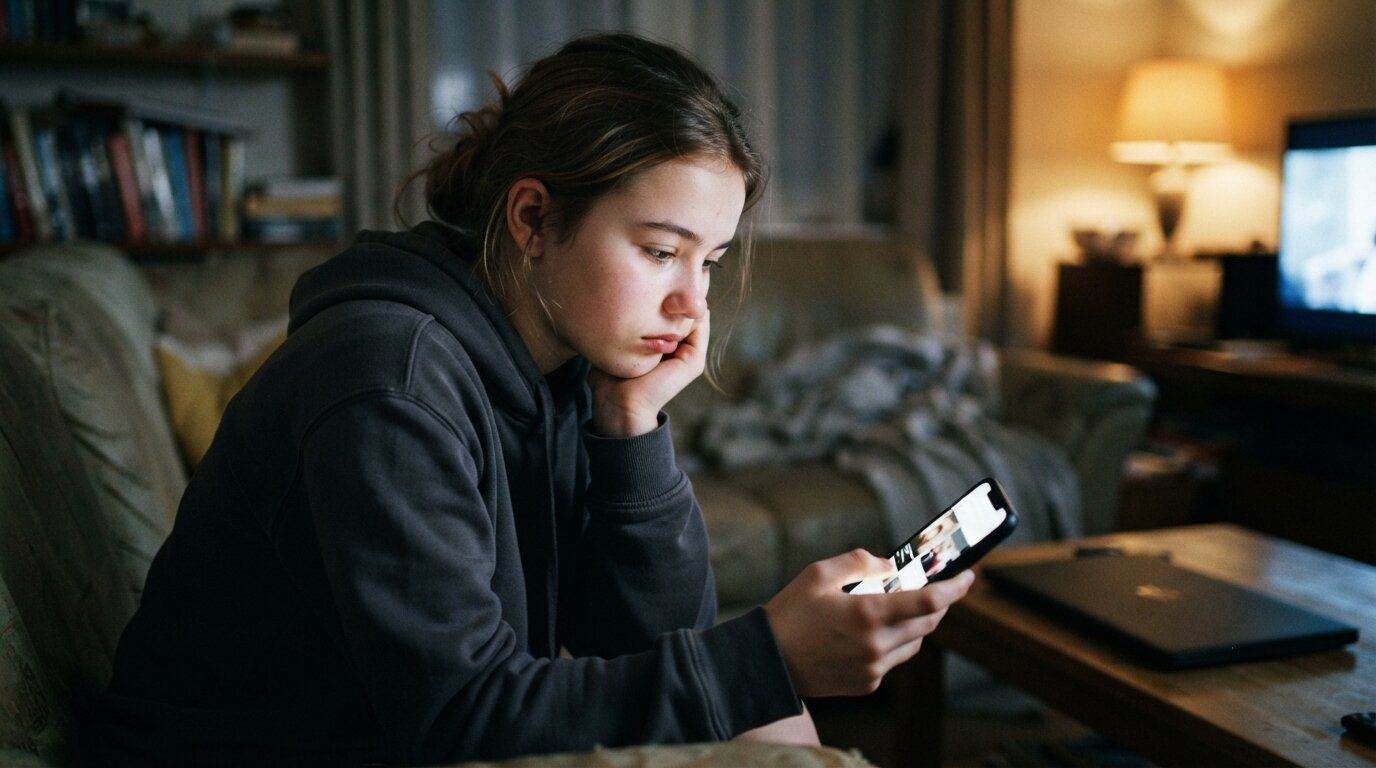
Every parent has had the argument. Every teenager has rolled their eyes at it. The phone is taking too much time, the apps are bad for you, something is wrong. For years, the concern felt real but hard to pin down — anxiety is common, phones are common, and correlation isn’t causation.
A new study has made the picture considerably harder to dismiss.
Researchers at UTHealth Houston tracked 1,066 young people from the age of 12 through seven annual surveys, following them from 2018 all the way to 2025. By the final wave, the average participant was nearly 20. They had grown up alongside TikTok. They were the first cohort to go through adolescence with short-form video as a constant backdrop. And when the researchers measured their mental health against how much time they spent on social media each day, the results followed a dose-response curve that held firm even after controlling for sex, race, ethnicity, and income.
Young adults who spent six or more hours daily on social media were 2.63 times more likely to show symptoms of anxiety than those who used it less than an hour a day. Their odds of reporting suicidal ideation in the past year were 3.23 times higher.
The relationship wasn’t a cliff edge — it was a slope. Anxiety and depression both climbed steadily as daily usage increased, from under one hour all the way through the six-hour threshold. Every level of additional use was associated with additional risk.
What the study actually measured
The cohort was racially and socioeconomically diverse: 46% Hispanic, 29% Black, 30% white, 16% Asian. Slightly more than half were female. Mental health was assessed using two validated clinical scales — the Center for Epidemiological Studies Depression scale and the Generalized Anxiety Disorder scale — plus a standardized measure of suicidal ideation from the DSM-5 diagnostic framework. These aren’t questionnaires designed to pick up mild discomfort. They identify probable clinical-level anxiety and depression.
Participants were asked how many hours they spent on social media per day across platforms including TikTok, Instagram, Snapchat, and X. To improve accuracy, they were instructed to check their actual phone screen time data before answering. That’s a meaningful methodological step: self-reported screen time tends to be underestimated when recalled from memory.
Among the 1,066 participants: 8.5% used social media less than one hour per day. More than a third — 36% — reported one to three hours. Another 38% fell in the three-to-six hour range. And 17.3%, or roughly one in six, reported using social media for more than six hours daily.
That last group was the most affected.
Girls, and the gender gap that widened at high usage
Across both sexes, the general pattern held: more time on social media, worse mental health outcomes. But the relationship was measurably stronger for girls when usage climbed past six hours.
Female participants reported higher overall social media use than male participants at every level. And at the highest usage tier, the anxiety association among girls was significantly more pronounced than among boys — the only outcome where a sex interaction reached statistical significance. Across probable anxiety, probable depression, and suicidal ideation, the patterns were broadly similar by gender. But something about the highest levels of use pushed girls’ anxiety scores further.
Lead researcher Jeff Temple, a professor at UTHealth Houston, offered one explanation: social comparison. “When teens are using social media, they’re comparing themselves to others. People only post the good on social media, typically, so they only see this happy life where everything’s perfect.”
For girls especially, the research literature has documented that visual social comparison — comparing your appearance, relationships, and life circumstances to curated images — is a reliable driver of anxiety and depressed mood. Short-form video algorithms, optimized for engagement rather than user wellbeing, deliver an essentially endless stream of such content.
What it does — and doesn’t — prove
The study is cross-sectional at the final wave, which means it captures a moment in time. It can document a correlation, not definitively prove a direction. Temple acknowledges this openly: the reverse may also be true. Young adults who are already anxious or depressed may turn to social media more — for distraction, connection, or escape — rather than having their distress caused by it.
“The opposite could also be true,” Temple said. “Young adults who are already experiencing symptoms of anxiety and depression may use social media more as a form of escape.”
This bidirectionality is well-established in the research literature. The honest interpretation is that heavy social media use and poor mental health likely reinforce each other in a feedback loop. Getting out of that loop may require addressing both simultaneously.
What this study does unusually well is its timing. Most previous research on social media and teen mental health either predates TikTok entirely or focused on high school or college students studied during the COVID-19 pandemic — a confounding variable that makes it difficult to isolate social media’s specific contribution. This cohort started at age 12 in 2018, before the short-form video era fully began, and was followed through it. The exposure they experienced is the one that exists today, not the one that existed in 2015.
The threshold that matters most
The number that stands out is six hours. Below it, the associations are present but more modest. Above it, the odds ratios jump sharply. This is not a study arguing that all social media use is harmful, or that one hour a day carries the same weight as six.
More than 17% of this cohort — a large, diverse sample of American young adults — was already at or beyond that threshold.
The American Psychological Association’s 2023 guidance suggested that social media use of more than three hours per day may be a point of concern for adolescents. This study suggests the risk curve continues rising well past that point. The question it leaves open — and which Temple frames as the urgent next step — is what to do about it. “Once we understand the problem and recognize the problem, then we can start answering the who, what, when, where, why, and how.”
The full study, “Associations Between Social Media Use and Mental Health in Emerging Adulthood” was published in Pediatrics Open Science by Jeff R. Temple, Elizabeth Baumler, and Leila Wood at UTHealth Houston.
Source: UTHealth Houston / Pediatrics Open Science. DOI: 10.1177/21677026261450607