Researchers spent 17 years following older adults and found that the slowest steppers died significantly earlier, and the difference was measured in milliseconds

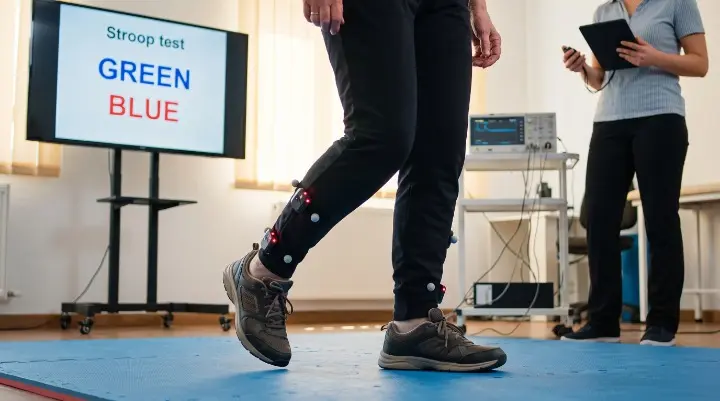
Somewhere in the gap between deciding to take a step and actually taking it, there is a number. It is measured in fractions of a second, invisible to casual observation, unremarkable to anyone watching. But researchers at Ben-Gurion University of the Negev have spent years following 120 older adults through the last chapters of their lives, and what they found in that fraction of a second is one of the more unsettling measurements in recent aging science. For every additional tenth of a second it took an older adult to initiate a voluntary step while simultaneously performing a cognitive task, their risk of dying during the follow-up period increased by 28 percent. The follow-up period lasted up to 17 years.
That is not a correlation between general frailty and mortality. It is not a proxy for age or chronic disease burden, the two variables physicians have relied on for generations to estimate how much time a patient has. It is a specific measurement of a specific physical action performed under a specific cognitive condition, and it predicted survival over nearly two decades with an accuracy that traditional clinical markers struggled to match.
Why a step under distraction is different from a step alone
The study, published in the journal Gerontology, tested participants under two conditions. In the first, they were asked to take a forward step as quickly as possible in response to a physical cue applied to their foot. In the second, they performed the same stepping task while simultaneously completing a modified version of the Stroop test, a well-validated cognitive challenge that requires naming the ink color of words printed in a conflicting color. The word “red” printed in blue ink requires the brain to suppress the automatic reading response and redirect attention toward the perceptual task of identifying color.
The critical insight behind the dual-task design is what it isolates. Basic sensory detection speed and nerve conduction velocity do not change meaningfully between the single-task and dual-task conditions. The peripheral nervous system works at roughly the same speed whether or not the brain is simultaneously occupied. What changes under cognitive load is central processing: the brain’s ability to allocate attention, manage competing demands, and translate a motor intention into a physical action without interference from the cognitive task running in parallel.
When the brain is older and its resources more limited, the dual task exposes that limitation in a measurable way. The step slows down. Not because the legs are weaker or the feet less responsive, but because the central nervous system is using a higher share of its available attentional capacity just to execute a movement that would be automatic in a younger or more cognitively robust person.
“Because sensory detection and basic nerve conduction speeds remain constant between simple and distracted stepping, any delay in initiating a step during the mental challenge is largely driven by central neural processing limitations,” the researchers explain.
What the numbers revealed across 17 years
The 120 participants were community-dwelling older adults, people living independently rather than in care facilities, which makes the findings more directly relevant to the general population of aging adults. Their stepping speed was measured at the start of the study. Then researchers waited, tracking survival outcomes for between 10 and 17 years.
The association that emerged was precise enough to be clinically actionable. For every 100-millisecond increase in step initiation time under the distracted condition, mortality risk rose by 28 percent. To put that in terms that translate to lived experience: imagine two people of the same age tested on the same day. One initiates a step in 400 milliseconds while naming ink colors. The other takes 500 milliseconds to do the same thing. That single 100-millisecond difference, less than a blink, corresponds to a 28 percent higher probability that the slower person dies earlier during the follow-up window.
Across the range of scores observed in the study, the gap between the fastest and slowest stepping quartiles translated into substantially different survival curves, with the slowest steppers showing markedly earlier mortality than the fastest at both age thresholds the researchers examined.
Static balance measures, including postural sway recorded while participants stood barefoot with eyes closed, also predicted mortality in the analysis. But they were less accurate and less sensitive than the dynamic stepping tests. The body in motion, under cognitive pressure, revealed more about its underlying state than the body standing still.
What a step actually measures
The reason a single stepping test can carry this much predictive information is that taking a voluntary step is not a simple act. It requires the brain to receive a sensory signal, interpret it as a cue to move, plan and initiate a motor program, coordinate balance and weight transfer, suppress the existing postural state, and execute the movement, all within a window measured in milliseconds.
In a young, healthy nervous system, these processes are so thoroughly automated that they consume almost no conscious resources. They happen below the threshold of awareness. But as the nervous system ages, that automation degrades. Processes that once ran in the background begin competing for attentional capacity. Adding a cognitive task to the physical demand of stepping exposes how far that degradation has progressed by measuring exactly how much the competition slows things down.
Prof. Itshak Melzer, who has led research on balance and gait in older adults for more than 25 years, frames the finding in the context of a larger clinical problem. About 30 percent of adults over 65 fall at least once a year. For those over 80, the rate is closer to 50 percent. In Israel, roughly 1,000 older adults arrive in emergency rooms daily because of a fall, many of them sustaining hip fractures that accelerate functional decline. The cascading effects of that first serious fall, reduced mobility, deconditioning, systemic health deterioration, are well documented. A test that can identify who is approaching that threshold years before the fall occurs addresses the problem at a fundamentally earlier stage.
The step is slow but it can be made faster
The researchers are explicit about one implication that separates this finding from a purely diagnostic observation: stepping speed under dual-task conditions is not fixed. Prior clinical trials have shown that targeted perturbation training and balance rehabilitation programs can measurably improve the speed and quality of voluntary stepping in older adults.
That makes the measurement not just a predictor but a potential target. An older adult who tests slowly on the dual-task stepping assessment is not receiving a verdict. They are receiving information about a modifiable aspect of their neurological function that, if addressed through the right kind of training, may improve. Whether that improvement translates into the kind of survival benefit the study documents is a question that future intervention trials will need to answer directly.
What the Ben-Gurion study establishes is the measurement’s validity as a window into something the body rarely makes visible: the combined state of neuromuscular vitality and central cognitive processing that together determine how much functional reserve an aging person actually has, independent of what their medical chart or birth certificate says about them.
The test takes a few minutes. The information it reveals, according to 17 years of follow-up data, may be more consequential than almost anything else a clinician currently measures.
Source
Itshak Melzer, Ofri Gans-Or, Anat Reiner-Benaim, Iuly Treger, Lars I.E. Oddsson. “Voluntary stepping parameters as predictors of long-term survival in older adults.” Gerontology, June 22, 2026.
DOI: 10.1159/000551264