A new clinical trial gave people psilocin directly, the compound that psilocybin becomes in the body, for the first time since 1960. It was better tolerated, had fewer side effects, and lasted less time.

Psychedelic therapy has staged one of the most remarkable returns in the history of medicine. After decades of prohibition following the 1970 Controlled Substances Act, psilocybin has re-entered clinical research with a credibility that would have been unimaginable twenty years ago. It has received FDA Breakthrough Therapy designation for treatment-resistant depression and major depressive disorder. Randomized controlled trials have documented its effects against standard antidepressants. Oregon and Colorado have legalized supervised therapeutic use. The field has moved faster than most expected.
Through all of this, clinical researchers have been studying the wrong molecule.
Not entirely wrong. Psilocybin is what occurs naturally in mushrooms. Psilocybin is what participants ingest when they take part in clinical trials. Psilocybin is what has accumulated the largest safety and efficacy database of any psychedelic under modern study. But psilocybin is not what produces the psychedelic experience in the brain. Before it can do anything, the body must convert it.
Within minutes of ingestion, alkaline phosphatase enzymes in the gut and liver dephosphorylate psilocybin, removing a phosphate group from the molecule and converting it into psilocin, or 4-hydroxy-N,N-dimethyltryptamine. Psilocin is the pharmacologically active compound. It crosses the blood-brain barrier, binds to 5-HT2A serotonin receptors throughout the cortex, and produces the perceptual, cognitive, and emotional changes that make psychedelic therapy possible. When researchers measure psilocybin’s effects on the brain, they are measuring psilocin’s effects on the brain. Psilocybin is a prodrug. Psilocin is the drug.
A new randomized crossover clinical trial from the University of California San Francisco, published in the Journal of Psychopharmacology, has done what the modern research era had not done before: it tested psilocin directly in humans and compared it head-to-head against psilocybin.
The last published human data on psilocin came from 1962, a study conducted under conditions that would not receive ethics approval today. In the six decades since, the field moved on to psilocybin and largely left psilocin uninvestigated, partly because of the practical challenge. Psilocin is chemically unstable. It degrades rapidly at room temperature and is sensitive to light and air in ways that make it difficult to manufacture and store in a form suitable for clinical use. Recent advances in botanical extraction techniques, producing stabilized psilocin directly from mushroom material, made the UCSF trial possible.
What the trial tested and how
The study enrolled participants who received three active drug conditions across separate sessions spaced four weeks apart in a randomized crossover design. Each participant received all three conditions, making each person their own control.
The first condition was oral psilocybin at 25 milligrams, the dose used in most clinical trials and generally considered a full therapeutic dose. The second was oral psilocin at 17.5 milligrams, a dose calculated to deliver equivalent active compound to the brain after accounting for the conversion step that psilocybin requires. The third was sublingual psilocin, administered as a tablet placed under the tongue for absorption through the mucous membranes rather than through gastrointestinal digestion. Sublingual doses were set lower, starting at 2.18 milligrams and escalating to 4.36 milligrams and then 8 milligrams across the session sequence, to assess safety and tolerability at a more cautious initial level.
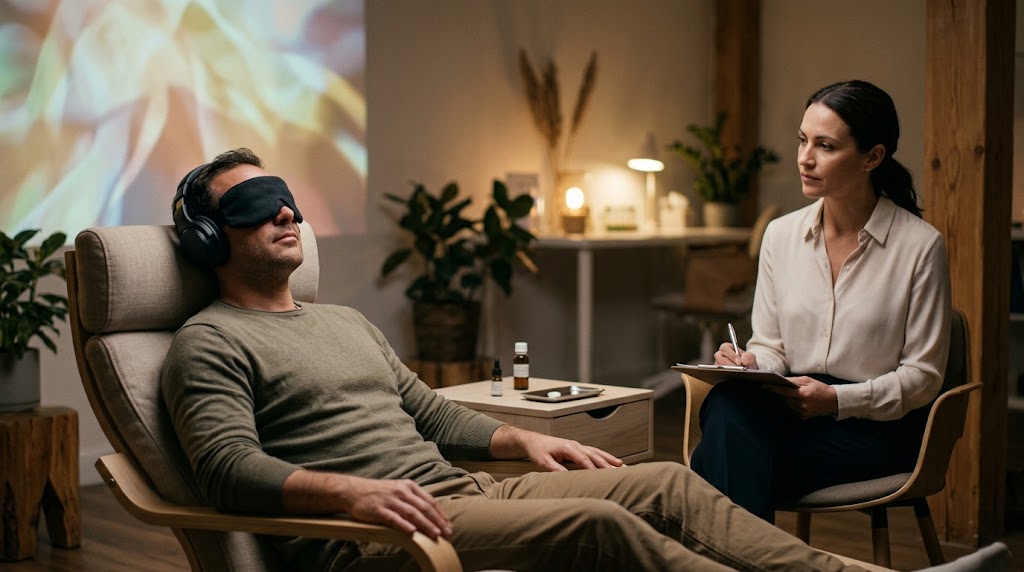
Sessions took place in a clinical setting with a therapist and assistant present throughout. Participants wore eyeshades and listened to curated music, the standard protocol for psychedelic clinical sessions. Researchers measured blood pressure and heart rate throughout each session. Participants rated the intensity and character of their subjective experience at multiple time points. Adverse effects were recorded systematically.
The sessions were long by the standards of most clinical research but typical for psychedelic trials. The question the researchers were most interested in was whether psilocin produced a meaningfully different safety and tolerability profile than psilocybin, and whether the route of administration changed anything further.
What psilocin did differently
Oral psilocin outperformed oral psilocybin on the primary tolerability measures. Participants reported lower rates of nausea with psilocin, one of the most consistently noted adverse effects of psilocybin therapy that can intensify the difficulty of sessions and discourage some patients from completing treatment. Cardiovascular strain was reduced: heart rate and blood pressure elevations, which are standard but unwanted features of psilocybin sessions, were smaller with psilocin.
The onset of effects was faster with psilocin. Because psilocin does not require the conversion step that psilocybin does, it reaches the brain more quickly after ingestion. Participants began experiencing the psychedelic state sooner, and the peak of the experience arrived earlier in the session.
The duration was shorter. This is potentially the most clinically significant finding. Psilocybin therapy sessions currently require six to eight hours of clinical monitoring, a major logistical and economic barrier to making this therapy accessible. A therapist’s full day is consumed by a single patient session. Clinic space is occupied for most of the working day. The direct cost of staffing psychedelic therapy at the intensity required for safety is one of the main reasons that even where the therapy is legal, it remains expensive and inaccessible.
Psilocin’s shorter duration, while preserving the essential character of the psychedelic experience, points toward sessions that could fit into a more sustainable clinical workflow. If the therapeutic effect is equivalent, a session that takes four to five hours instead of seven or eight reduces per-patient costs substantially, with direct implications for whether the therapy can reach the populations who need it most.
“By bypassing the need for metabolic conversion, psilocin offers a potentially cleaner pharmacokinetic profile,” the researchers wrote. “These properties may have practical advantages for clinical implementation.”
Why psilocin was never studied until now
The gap between the 1962 psilocin data and this trial is not accidental. Several factors converged to steer the field toward psilocybin rather than its active metabolite.
Psilocin’s chemical instability made it difficult to work with. Unlike psilocybin, which is relatively stable at room temperature and can be stored in powder or capsule form for extended periods, psilocin oxidizes readily and degrades when exposed to air, light, or moisture. Manufacturing a standardized, stable psilocin product suitable for human administration required either synthetic chemistry that was unavailable for this trial, or botanical extraction techniques that preserved the compound’s integrity.
The company Filament Health, which supplied the botanical psilocin used in the UCSF trial, developed an extraction and stabilization process that solved this problem. The existence of a stable psilocin product suitable for human ingestion is what made the trial feasible. Without that development, the 1962 data would have remained the only human trial ever conducted.
Regulatory scheduling also played a role. Both psilocybin and psilocin are Schedule I controlled substances in the United States, requiring DEA licensing to study. The regulatory pathway for psilocybin research is better established because more investigators have navigated it. Psilocin research required building a comparable infrastructure essentially from scratch.
What sublingual psilocin showed
The sublingual administration arm of the trial was exploratory rather than directly comparable to the oral conditions, given the lower doses tested. The doses started at 2.18 milligrams and reached a maximum of 8 milligrams, substantially below the full therapeutic doses in the oral conditions.
At these doses, sublingual psilocin was well tolerated with no significant safety signals. Participants found the route acceptable and the experience manageable. The pharmacokinetic profile, how quickly the compound was absorbed and how it behaved in the body, differed from oral administration in ways consistent with mucosal absorption bypassing the digestive system.
The lower doses produced less intense experiences than the full therapeutic oral doses, as expected. The trial was not designed to test sublingual psilocin at therapeutic intensity, but rather to establish whether the route was safe enough to explore further. The researchers consider the sublingual results a foundation for future dose-escalation studies that would test whether sublingual administration at higher doses could offer additional advantages, potentially faster onset and more precise dose control, while maintaining tolerability.
What this means for psychedelic therapy
The UCSF trial does not establish psilocin as a superior therapeutic agent over psilocybin. It establishes that psilocin is tolerable in humans at full therapeutic doses using modern protocols, that its tolerability profile is meaningfully better than psilocybin’s on several clinically relevant measures, and that its pharmacokinetic properties may offer practical advantages for clinical implementation.
Whether psilocin produces better therapeutic outcomes than psilocybin for depression, anxiety, addiction, or other conditions requires future trials specifically designed to test efficacy. The existing evidence base for psychedelic therapy rests almost entirely on psilocybin data. Whether that evidence base translates to psilocin, given their shared mechanism of action and the fact that psilocybin’s effects are mediated entirely by psilocin anyway, is theoretically plausible but not yet empirically confirmed.
For patients, the most relevant implication is indirect: a more tolerable psychedelic with a shorter session duration may expand access and reduce the barriers that currently prevent many people who could benefit from the therapy from receiving it. The intensity of the psilocybin experience, particularly the nausea, cardiovascular effects, and duration, deters some patients from attempting the treatment and contributes to dropout rates in clinical studies. Removing those barriers could change who is able to complete a full therapeutic course.
“These findings support further investigation of psilocin as a potentially more clinically practical alternative to psilocybin,” the researchers concluded, “with implications for treatment accessibility and patient experience.”
The practical and economic argument for psilocin is not that it works better on the brain. It is that it may be easier to deliver the same benefit more reliably, more comfortably, and more efficiently to more people.
The study, “A randomized crossover trial comparing the acute physiological and psychological effects of botanical formulations of oral psilocybin, oral psilocin, and sublingual psilocin”, was authored by Marlene L. Tai, Balázs Szigeti, Amanda E. Downey, and colleagues at the University of California San Francisco, and published in the Journal of Psychopharmacology in 2026.
Source: University of California San Francisco. DOI: 10.1177/02698811261478603