New discovery found why some people can’t store fat even when they overeat

Losing the ability to burn fat actually makes you disappear. This is the biological paradox of lipodystrophy, a condition where the body essentially forgets how to store energy in adipose tissue. For decades, the scientific community believed that an enzyme called Hormone-Sensitive Lipase had one job: sitting on the surface of fat droplets and breaking them down when you need a boost of energy. If you lacked this enzyme, logic dictated you should become obese because the fat would be trapped in your cells.
But reality told a different story. Humans and mice missing this enzyme don’t get bigger. They waste away. A massive international effort led by Dominique Langin at the Université de Toulouse has finally found the reason why. It turns out Hormone-Sensitive Lipase has a double life as a genetic regulator hidden inside the nucleus, the very brain of the cell. This discovery, published in Cell Metabolism, suggests that the fat burner we’ve known since the 1960s is actually the architect of your fat cells’ survival.
The Ghost in the Nucleus
If you look at a fat cell through a confocal microscope, you see this enzyme everywhere. While most of it hangs out in the cytosol, a significant pool lives inside the nucleus, associated directly with the chromatin. The density inside the nucleus is only 1.6 times lower than in the rest of the cell.
Jérémy Dufau and the research team found that this nuclear presence isn’t passive. The enzyme physically interacts with the heavy machinery of life, including RNA polymerase II and specialized proteins that manage how your genes are read. When it sits inside the nucleus, it is part of a program that keeps your fat cells healthy and functional. Without it, the entire system collapses into a state of cellular confusion.
The SMAD3 Escort Service
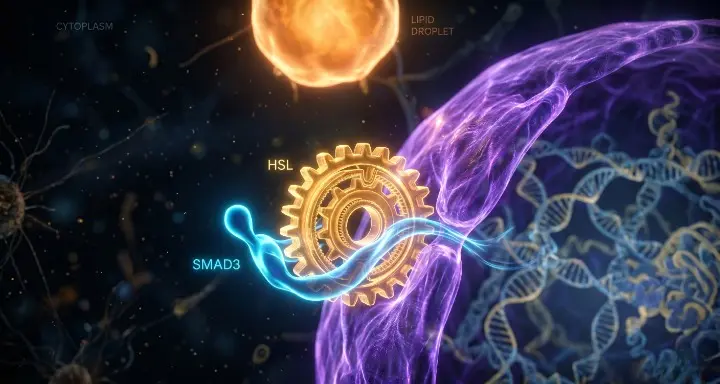
How does a fat-breaking enzyme get past the high-security gates of the nucleus? It doesn’t walk in alone. The researchers discovered that it hitches a ride with a protein called SMAD3, a key player in the TGF-beta signaling pathway.
This is a high-stakes partnership. When TGF-beta signals the cell, the two proteins lock together and move into the nucleus. Once inside, they act as a repressive force, specifically targeting a gene called PPARGC1A, which produces a protein known as PGC-1alpha. PGC-1alpha is widely understood as the master regulator of mitochondrial energy. By keeping this gene in check, the enzyme tells the cell to slow down its internal power plants.
The Price of Missing the Switch
To prove that the nucleus was the key, the team used CRISPR to create a nuclear-only mouse. These animals were engineered so the enzyme was physically locked inside the nucleus and couldn’t travel to the cytosol to burn fat.
The results stunned the lab. Unlike mice with no enzyme at all, who suffered from shrunken fat pads and liver damage, the nuclear-only mice had perfectly normal fat tissue. Their bodies could still store fat even though they couldn’t burn it through the traditional pathway. As long as the enzyme was communicating with the DNA, the fat cells stayed alive and functional.
There was a catch, though. These nuclear-only mice were infertile. While the nucleus is enough to keep fat cells healthy, the enzyme’s traditional role in the cytosol is still essential for other vital functions.
The Adrenaline Ejection
Your body has a built-in mechanism to clear this enzyme out of your DNA when you need it elsewhere. When you fast or when adrenaline floods your system, a signaling pathway triggers a chemical tag on the enzyme that acts as an eviction notice. It forces the enzyme to exit the nucleus and rush to the surface of fat droplets.
Once it leaves, the repression on the mitochondrial gene is lifted. Your cells ramp up their energy processing and begin burning the fat being released. It is a perfectly coordinated sequence: the command center is cleared so the actual work of burning fuel can begin.
The Obesity Trap
In a healthy body, this shuttling between the nucleus and the fat droplets is seamless. But in a state of chronic high-fat feeding, the coordination breaks down. In obese mice, the enzyme begins to accumulate and stay trapped inside the nucleus.
This creates a metabolic bottleneck. Too much nuclear presence means constant suppression of the mitochondria and an overproduction of the extracellular matrix, the biological scaffolding that can harden into fibrosis. Fat cells lose their identity. They become stiff, metabolically sluggish, and unable to manage energy properly.
This research changes what we thought we knew about obesity. We used to think it was simply about having too much fat. Now we know it is about fat cells that have lost their internal balance because a single gatekeeper protein is stuck in the wrong room. For the billions globally living with metabolic disease, the target isn’t just burning more fat. It is about restoring the conversation between this enzyme and the DNA it was never supposed to stop talking to.