New research confirms a child who wasn’t held enough grows into an adult who can’t feel safe

Nobody talks about touch the way we talk about memory. We obsess over what we saw, what we heard, what was said to us in some pivotal moment. But your skin has been quietly filing everything away since before you knew what filing meant.
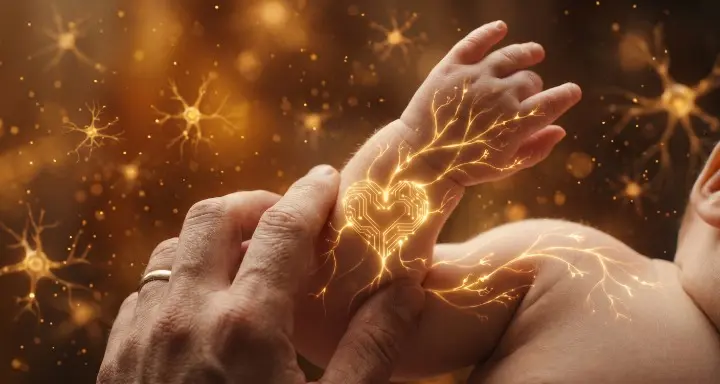
A study published in Neuroscience & Biobehavioral Reviews put a name to something researchers have been circling for years: affective tactile memory. It sounds clinical, but the idea is almost unsettling in how personal it is. Every time someone held you gently as an infant, a specific set of nerve fibers recorded it. And those fibers are still active right now, in your adult body, today.
There are actually two touch systems running in parallel
Most of what you feel on a daily basis moves through what are called Aβ fibers. Fast, precise, practical. They tell you the stovetop is hot, the fabric is scratchy, the handshake is firm. This is touch as information.
But underneath that runs something slower and stranger. Unmyelinated C-tactile afferents, or CT fibers, operate almost like a second nervous system entirely. They don’t care about temperature or texture. What they respond to, specifically, is the pace of a human caress. The slow, deliberate kind. A parent’s hand on a child’s back.
When those fibers fire, the signal doesn’t go to the same processing areas as ordinary touch. It routes directly into emotional territory, into the parts of your brain that decide whether you are safe or in danger. You don’t think your way through it. It just lands.
The brain builds something permanent out of it
What happens after that signal arrives is where it gets interesting. The insula pulls together the sensory and emotional data. The amygdala flags the moment as significant. The hippocampus stitches it into memory. The orbitofrontal cortex, somewhat remarkably, calculates how rewarding the whole thing felt.
This isn’t one memory being formed. It’s two. There’s the kind you might actually remember: a specific hug, a hand on your shoulder during something hard. And then there’s the kind that never surfaces consciously at all. The implicit record. The one that shapes, without your awareness, how easily you trust people, how your nervous system responds to stress, whether your body reads closeness as comfort or as something to brace against.
That second type is the one that really runs the show.
What happens when those early records are sparse
The research is uncomfortable on this point, but worth sitting with. Children who grew up without much nurturing physical contact don’t just miss out on warmth in the moment. Their brains, over time, actually become less capable of registering the pleasantness of gentle touch later in life. The biological signal, that quiet message of you are okay, someone is here, gets harder to receive.
Adults with insecure attachment styles often show a measurably reduced ability to distinguish between touch that is affectionate and touch that is simply neutral. The calibration is off. Not because of any personal failing, but because the hardware was shaped by what it did or didn’t experience early on.
Oxytocin plays into this too. Consistent nurturing touch in infancy tends to trigger it reliably, and that chemical response becomes part of the template. When the template is incomplete, the whole downstream system feels it.
This is not muscle memory
For a long time, researchers lumped physical memory into the procedural category alongside riding a bike or learning a golf swing. But affective tactile memory doesn’t fit there. It has nothing to do with motor skill. It is, at its core, an emotional and relational record, one that eventually stops being a collection of specific moments and becomes a kind of worldview.
You don’t remember every comforting touch you ever received. What you’re left with is a generalized sense, absorbed rather than reasoned, of whether touch means safety or something else. That sense influences how quickly your body settles after a stressful event. It shapes your baseline.
Where this leaves us
We’re living in a moment of profound physical disconnection from each other, and our nervous systems were not designed for it. CT fibers still need that slow, rhythmic activation. The biology hasn’t caught up to the screen age.
Recognizing that touch is its own memory system opens something up therapeutically. For people whose early tactile records were marked more by absence or fear than by warmth, the path forward isn’t only verbal. It may involve finding ways to write new information into the body, experiences that over time can begin to replace old signals of danger with something closer to safety.
The body has been keeping records the mind never had access to. It might finally be time to look at them.