A randomized trial of 16,683 college students found that collecting phones at the start of class raised grades, most of all for struggling students. The bigger surprise was how students felt about it afterward.

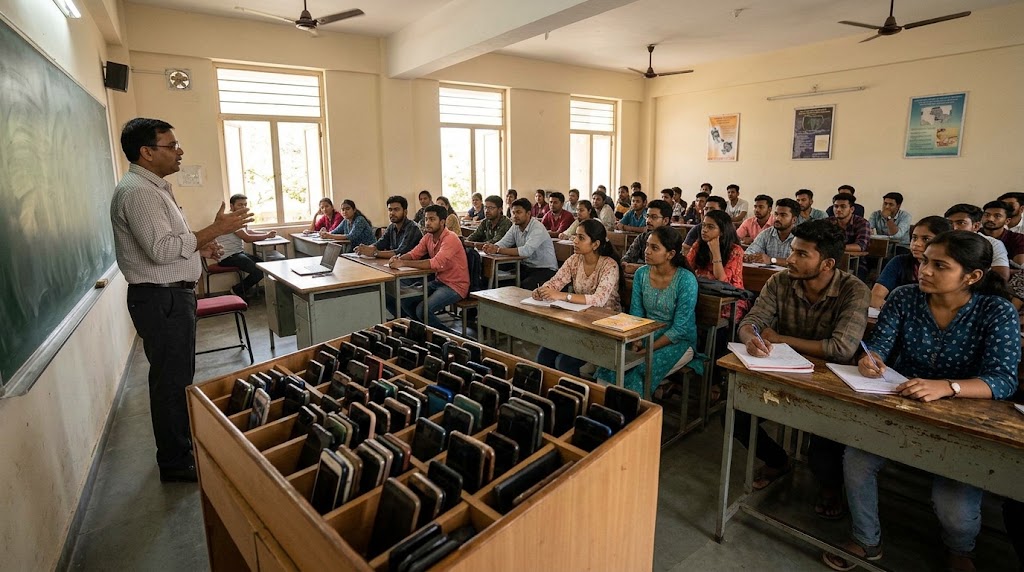
Schools and colleges around the world are banning phones in class, with little hard evidence on whether it works. So researchers from the University of Pennsylvania, Jawaharlal Nehru University and the University of Copenhagen ran a real experiment. Across 10 colleges in India, 2,305 courses were randomly assigned either to collect phones at the start of every lecture or to carry on as usual. Then they compared the grades of 16,683 students.
Students in the phone-free courses got better grades. The average gain was modest, about 0.09 standard deviations, roughly enough to move a typical student from the middle of the class to around the 53rd percentile.
The gain was not spread evenly. Students who came in with weaker grades improved about twice as much as the average, and first-year students also gained more. Stronger students showed little change. As a result, the classroom phone ban narrowed the gap between the top and bottom of the class.
“That we observe particular benefits for lower-performing students is critical to advancing educational equity,” the researchers write.
That pattern matches older evidence. A 2016 study of English secondary schools found that test scores rose after schools banned phones, with the biggest gains among low-achieving pupils. But that study compared schools that chose to ban phones with schools that did not, so it could not rule out other differences between them.
Other research has been less encouraging. A 2025 study of English schools in The Lancet Regional Health Europe found no link between restrictive school phone policies and better mental wellbeing. Most bans are judged on mental health or focus, and the evidence on those remains mixed.
The new study’s advantage is randomization. Because courses were assigned by chance, the two groups of students were alike in every way except the phones. The trial ran across 742 teachers, and phones were physically collected rather than just banned on paper.
The second finding is the one few people expected. You might think students would resent losing their phones. Instead, after a semester without phones in class, those in the phone-free courses became more supportive of bans, saw more benefits in them, and were less keen on unrestricted phone use than students who kept their phones. Even higher-performing students, who gained little in grades, backed the policy.
The grade gains did not come from better attendance. Classroom observers recorded fewer disruptions and more engaged teaching in phone-free lectures, which points to less distraction as the likely reason.
The researchers also write that because first-year and struggling students benefited most, impacts “might be more pronounced at earlier educational stages,” such as school.
For parents and teachers, the takeaway is practical. A classroom phone ban will not transform grades on its own, but for students who are already struggling, physically removing the phone seems to help. The open question is what phones do to attention in the first place, which one recent theory frames as a change in whether focusing feels worth it. Screen time outside class is a separate debate, and some research has found surprising benefits there.
There are limits to what this shows. The trial took place in Indian higher education, and results may differ in high schools or in other countries. The average effect was small, and students and teachers knew which courses had the ban, so neither group was blinded.
Phones were removed only during lectures, so the study says nothing about phone use at home, sleep or social media. The researchers measured grades and attitudes over one semester, not long-term learning.
Source
Sungu A, Choudhury PK, Bjerre-Nielsen A. “Phones impede learning: Evidence from a massive phone-free classroom experiment.” Science, 2026.
DOI: 10.1126/science.aef7249
Also cited
Beland LP, Murphy R. “Ill communication: Technology, distraction & student performance.” Labour Economics, 2016.
DOI: 10.1016/j.labeco.2016.04.004
Goodyear VA, et al. “School phone policies and their association with mental wellbeing, phone use, and social media use (SMART Schools): a cross-sectional observational study.” The Lancet Regional Health Europe, 2025.
DOI: 10.1016/j.lanepe.2025.101211