Scientists found that the belly fat you carry in midlife is linked to Alzheimer’s proteins in your blood decades later, and after 70 the pattern flips

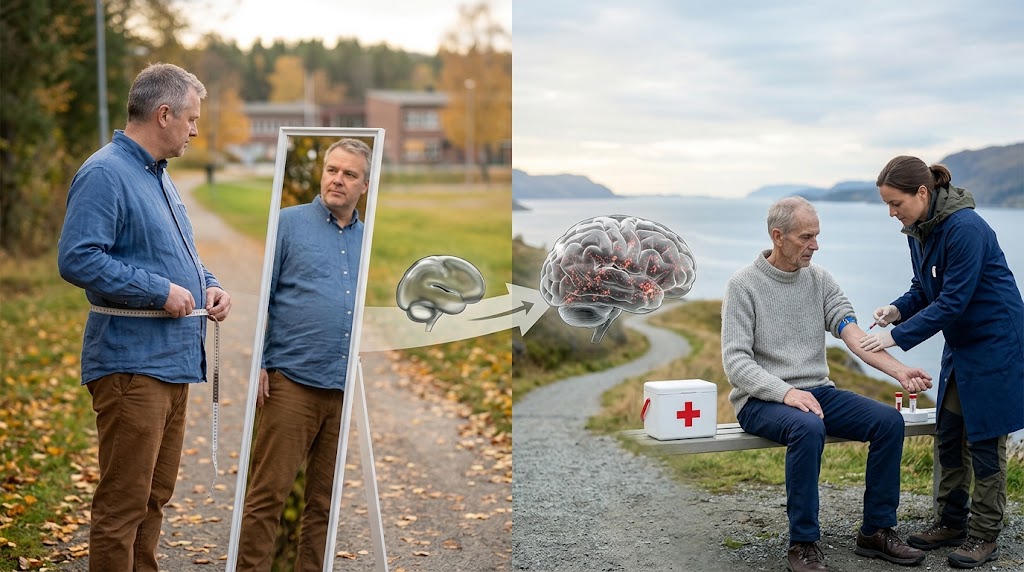
Most people know their weight. Far fewer know their waist-to-height ratio, a simple number that captures how much fat sits around the middle. Researchers in Norway followed 8,797 people across 35 years, measuring their waists and weight again and again, then tested their blood in old age for p-tau217, a protein fragment that tracks the brain changes of Alzheimer’s disease. People who carried the most belly fat in midlife had higher levels of that protein decades later. What the researchers found when they looked at the same measurements taken after 70 was harder to explain.
The study, published in Neurology, drew on the Trøndelag Health Study (HUNT), one of the longest-running population studies in Europe. Body mass index was measured four times between 1984 and 2019, and waist-to-height ratio three times between 1995 and 2019. In the final wave, from 2017 to 2019, participants aged 70 and older gave blood samples and had standardized cognitive assessments. Their average age was 77.8, and 53.5% were women.
The researchers counted anyone with p-tau217 at or above 0.63 picograms per milliliter as p-tau217 positive. That applied to 2,649 participants, or 30.1%. A positive result combined with a clinical dementia diagnosis counted as biomarker-verified Alzheimer’s dementia, which applied to 659 people, or 7%.
Belly fat in midlife and the blood test decades later
Waist-to-height ratio is your waist measurement divided by your height. The study’s cutoff was 0.60, meaning a waist at least 60% of height. For someone 175 centimeters tall, that is a waist of 105 centimeters or more.
People who reached that cutoff in midlife had 12.8% higher p-tau217 concentrations in late life than those below it. Their relative risk of testing p-tau217 positive was 1.55. For biomarker-verified Alzheimer’s dementia it was 1.84, an 84% higher relative risk. Body mass index showed a similar pattern: midlife obesity was linked to higher p-tau217 and a higher risk of biomarker-verified Alzheimer’s dementia.
The authors conclude that midlife fat around the middle, along with general obesity, represents “modifiable risk factors for AD pathology and AD dementia.” They suggest waist-to-height ratio could help flag people at higher risk early.
After 70, the pattern flips
When the researchers looked at the same measurements taken in late life, the association ran the other way. People with a waist-to-height ratio of 0.60 or higher after 70 had 15.6% lower p-tau217 concentrations. Their relative risk of testing positive was 0.49, and their relative risk of biomarker-verified Alzheimer’s dementia was 0.63. Late-life overweight and obesity measured by body mass index showed the same reversal.
Tracking people backward made the timeline clearer. Among those who ended up p-tau217 positive or with Alzheimer’s dementia, body fat was higher in midlife and then dropped below that of their peers by late life.
This does not mean extra weight protects the brain after 70. Unintended weight loss often comes before a dementia diagnosis, as the disease affects appetite, metabolism, and everyday tasks like shopping and cooking. There is also survival bias. Obesity raises the risk of dying earlier, so the people with midlife obesity who lived past 70 and entered the study may have been unusually healthy in other ways.
What the study cannot show
This is an observational study, so it shows associations, not that belly fat causes Alzheimer’s disease. The researchers adjusted for education, physical activity, smoking, mental health symptoms, and the APOE e4 gene variant, but other factors could still play a role.
P-tau217 was measured only once, at the end of the study, so the researchers could not see when levels began to rise. The participants were mostly from a single, fairly homogeneous Norwegian population, and the results may differ elsewhere. Because everyone had to survive past 70 to be included, the people at highest risk from midlife obesity may be missing from the data.
The study was funded by the South-Eastern Norway Regional Health Authority.
Source
Zotcheva E, Strand BH, Sunde A, et al. “Associations of Anthropometry Measures Across 35 Years With Late-Life Plasma P-tau217 and Dementia: The HUNT Study.” Neurology, 2026;106(12):e218093.
DOI: 10.1212/WNL.0000000000218093