MIT scientists watched the fluid that washes the brain during deep sleep and found much weaker waves in older adults, and it wasn’t just because they slept less

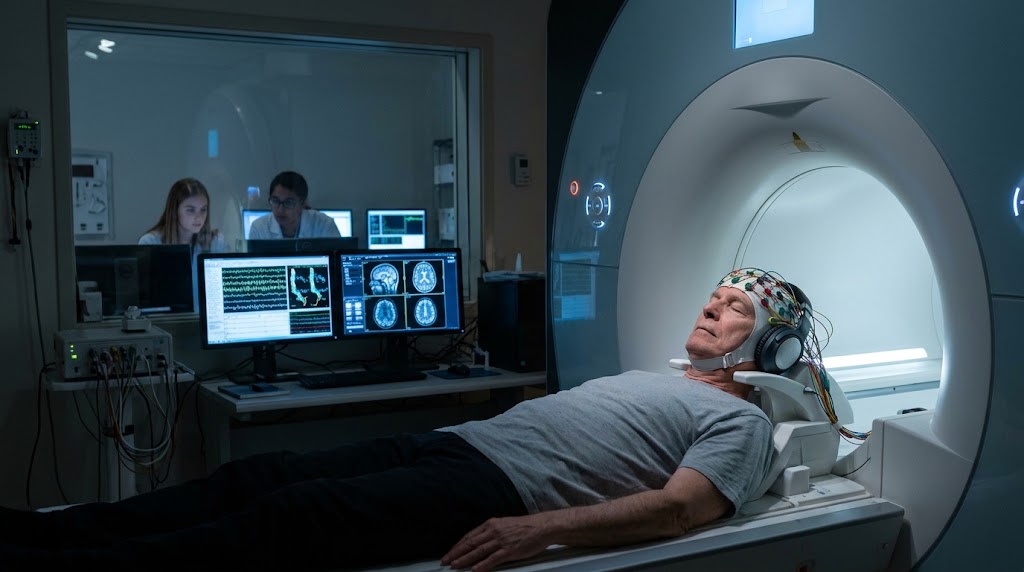
During deep sleep, slow pulses of cerebrospinal fluid wash through the brain, a process researchers think helps clear away waste. Many scientists have suspected this cleaning slows down with age. An MIT team scanned young adults aged 18 to 39 and older adults aged 60 to 84 as they slept in an MRI scanner late at night, recording brain waves, blood flow and fluid movement at the same time.
The fluid waves in older adults were significantly smaller. And it was not simply because older people slept less. The weaker waves tracked weaker slow waves, the large, rolling brain rhythms of deep sleep.
The team also found part of the reason. In older adults, blood vessels responded less to brain activity, and that weaker link between neurons and blood flow explained much of the drop in fluid flow, though not all of it.
Cerebrospinal fluid is the clear liquid that cushions the brain and spinal cord. In 2019, a team led by the same senior researcher, Laura Lewis, showed in a study in Science that during deep sleep this fluid moves in large waves, and that the slow brain waves of deep sleep drive them.
The order of events goes like this. Slow waves sweep across the brain, blood flows out of the head, and fluid rushes in to fill the space. Because this kind of fluid flow is thought to help clear proteins linked to Alzheimer’s disease, scientists have wanted to know what happens to it as we age.
The new study, led by Sydney Bailes and Stephanie Williams in Lewis’s lab, used about two hours of late-night scanning for each volunteer. Fast functional MRI tracked blood and fluid flow while EEG recorded brain waves.
To test how well blood vessels responded to brain activity, the researchers showed volunteers a flickering checkerboard and measured the blood flow it triggered. They also asked people to hold their breath, which normally makes blood vessels widen. Both responses were weaker in older adults.
Brain shrinkage mattered too. Older adults with more loss of gray matter tended to show a bigger decline in fluid flow.
“Aging is so complex,” Bailes said. Sleep, blood vessels and brain structure all change at once, which is why the team measured them together.
The most hopeful finding was that the decline was not universal. Some older adults had fluid waves that looked just like those of the young volunteers.
“We know that people age really differently,” Lewis said. “It’s really intriguing that for some of these older adults, their CSF fell right in the range of the healthy young adults.”
That echoes earlier work on how sleep and loneliness shape the aging brain, including our report on lonely brain waves, sleep, memory and tau, and on napping and dementia risk in older adults.
The researchers are already looking at ways to boost fluid flow. In young adults, bursts of pink noise played during sleep increased it. That has not yet been tested in older people.
For now, the practical message is the familiar one: deep sleep matters, and the things that protect blood vessels, such as managing blood pressure and staying active, may matter for the brain’s cleaning system as well. Poor sleep has also been tied to brain health, diabetes, heart disease and stroke.
There are limits. The study compared two age groups at a single point in time, so it cannot show how fluid flow changes within one person over years. Sleeping in a noisy MRI scanner is not normal sleep. And the study did not measure waste clearance directly or link fluid flow to memory or dementia.
The work was funded by the National Institutes of Health and other sources.
Source
Bailes S, Williams S, et al. “The aging human brain exhibits reduced hemodynamic and cerebrospinal fluid flow waves during sleep.” Nature Aging, 2026.
DOI: 10.1038/s43587-026-01270-4
Also cited
Fultz NE, Bonmassar G, Setsompop K, et al. “Coupled electrophysiological, hemodynamic, and cerebrospinal fluid oscillations in human sleep.” Science, 2019.
DOI: 10.1126/science.aax5440