The creatine supplement millions take for muscle gains raised brain creatine by 11% in a small Alzheimer’s trial.

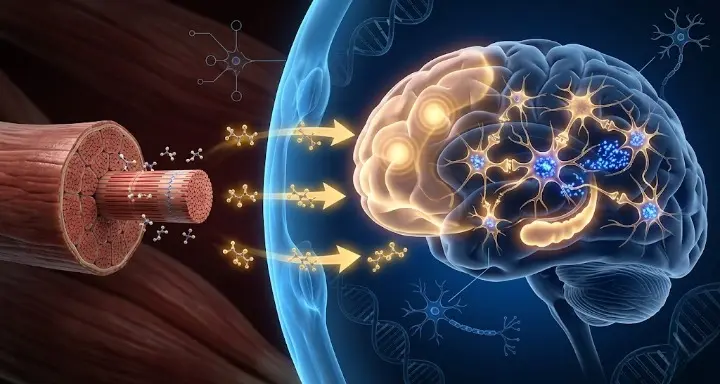
Creatine is one of the most researched supplements in sports. People take it for their muscles, and they measure their doses by how much weight they can add to a bench press or how quickly they recover between sets. Far fewer know that researchers are now testing whether the same supplement can raise creatine levels in the brain and change how it performs, and early studies are only beginning to answer that.
A 2025 review in the Journal of Psychiatry and Brain Science, together with a small pilot trial in Alzheimer’s and Dementia: Translational Research and Clinical Interventions, sets out where the evidence stands. It spans cognitive performance in healthy adults, sleep deprivation, depression, and Alzheimer’s disease. The most striking result comes from the Alzheimer’s pilot, where brain creatine rose 11% and patients scored higher on several cognitive tests. But that trial had no placebo group, and its authors say it cannot show that creatine works.
Why the Brain Needs Creatine
The brain is the most energy-demanding organ in the human body, consuming approximately 20% of the body’s energy at rest despite representing only 2% of its mass. Neurons need a continuous supply of ATP, adenosine triphosphate, the molecule that powers virtually every cellular process from maintaining ion gradients across membranes to releasing neurotransmitters at synapses.
Creatine plays a role in that supply. Inside cells, creatine picks up a phosphate group and is stored as phosphocreatine, which can hand that phosphate back to regenerate ATP quickly.
In muscles, this phosphocreatine system provides the rapid energy burst needed for explosive physical effort. In neurons, it serves as an energy buffer during periods of high metabolic demand. When a neuron fires rapidly, ATP consumption spikes, and the phosphocreatine system can fill the gap faster than glycolysis or oxidative phosphorylation can.
The importance of the system shows in creatine deficiency syndromes, rare conditions in which brain creatine is depleted and mental and neurodevelopmental problems follow. According to the review, supplementation partly reverses them.
What Happens to Brain Creatine as You Age
Researchers have proposed that impaired brain energy metabolism, including dysfunction in the creatine system, may contribute to Alzheimer’s disease, which makes the creatine system a target worth testing.
Brain scans using magnetic resonance spectroscopy have found lower phosphocreatine in people with Alzheimer’s, and in later stages lower levels of brain-specific creatine kinase, the enzyme that uses it. People who carry the APOE4 gene variant but have no dementia have been found to have lower brain creatine than non-carriers, which tracked with worse test performance. Researchers have hypothesized that mitochondrial dysfunction leaves the neurons most involved in memory chronically short of energy, a state they describe as a bioenergetic crisis.
This is why researchers began asking whether supplementing creatine could restore brain energy levels in people whose neurons were already struggling.
The Clinical Trial That Tested It
The CABA trial, short for Creatine to Augment Bioenergetics in Alzheimer’s, was run at the University of Kansas Medical Center and published in 2025. It enrolled 20 patients with Alzheimer’s disease, around 73 years old on average. Each took 20 grams of creatine monohydrate a day, split into two 10-gram doses, for eight weeks.
Blood creatine rose. Total brain creatine, measured by magnetic resonance spectroscopy in a slab covering frontal and parietal regions, rose 11% on average, from 330.5 to 366.9 units, and increased in 85% of participants. After eight weeks, patients scored higher on total cognition, fluid cognition, a working memory test (list sorting), and oral reading, with a borderline improvement on an attention test (p = 0.05). They did not improve on the Mini-Mental State Examination, on episodic memory, or on several other tests. Changes in brain creatine tracked with the change in oral reading and crystallized cognition, but not with the gains in total cognition, fluid cognition, or list sorting.
Study partners reported 13 adverse events, all mild, including muscle cramping, diarrhea, constipation, nausea, facial flushing, and sleep disturbance. The only safety lab that changed significantly was serum creatinine, which rose from 0.94 to 1.25 mg/dL and which the authors described as a slight increase. Two people were excluded before the trial because of elevated kidney labs at screening.
The trial was a single-arm pilot. Every participant received creatine, with no placebo group and no control group. The authors wrote that they cannot rule out that the improvements reflect repeat testing, placebo effects, or other artifacts, that the results “merely provide preliminary support” for their hypothesis, and that the design prevents conclusions about efficacy. They call for larger placebo-controlled trials. According to the paper, it is the first trial of creatine as an add-on therapy in people with Alzheimer’s.
The authors note that creatine is inexpensive, so if a larger trial did show a benefit, the public health implications could be substantial. An 11% rise in brain creatine is enough to justify that trial. It is not enough to say the supplement works.
What Creatine Does for Healthy Brains
The Alzheimer’s pilot is the most dramatic finding, but it is also the least certain. A systematic review and meta-analysis published in Frontiers in Nutrition in 2024, cited in the review, found that creatine supplementation may improve memory, attention time, and information processing speed in healthy adults. In healthy older adults, a separate systematic review found gains in short-term memory and reasoning, with unclear effects on other cognitive domains.
The review says the most robust evidence comes from times of metabolic stress, exactly the conditions where the phosphocreatine buffer should matter most. In a double-blind, randomized crossover trial published in Scientific Reports, 15 healthy adults received a single high dose of creatine, 0.35 grams per kilogram of body weight and several times a typical serving, before 21 hours of sleep deprivation. Compared with placebo, brain phosphocreatine rose and subjective fatigue was lower, and creatine softened the changes in brain phosphates, pH, and cognitive performance that sleep loss caused. The brain running low on sleep is a brain running low on energy, and creatine may partially compensate for that deficit.
Creatine has also drawn attention in depression research, though the evidence is early. In a study of 22,692 US adults, higher dietary creatine intake was associated with lower depression risk, which shows association only. In a dose-ranging imaging study of adolescent girls whose depression had not responded to SSRIs, 2, 4, or 10 grams a day for eight weeks raised frontal lobe phosphocreatine by 4.6%, 4.1%, and 9.1%, and higher phosphocreatine went with lower depression scores. The review notes that most depression studies used 5 grams a day or less.
The Blood-Brain Barrier Question
One detail that has historically complicated creatine’s brain story is the blood-brain barrier. The brain is selective about what it allows in from the bloodstream, and creatine crosses it more slowly than it enters muscle. The brain holds far less creatine than muscle, about 4 to 5 millimolar compared with 35 to 40. The review reports that supplementation raises brain creatine by about 10%, roughly half the rise seen in muscle, possibly because the body cuts its own creatine production when it receives creatine from outside.
Human studies give mixed results. In the Alzheimer’s pilot, brain creatine did rise at 20 grams a day, though that trial was small and had no comparison group. In a 1999 study of six healthy young adults, four weeks of 20 grams a day raised total brain creatine by about 8.7%, and levels returned to baseline within three months of stopping. A 2017 study giving about 25 grams a day for a week found no significant rise in young or older adults, and a 2023 study of 10 or 20 grams a day for six weeks found no change in cognitive performance in healthy young adults. The review adds that many studies using about 5 grams a day for short periods found similar null results, and it argues that higher doses or longer use may be needed.
The optimal dose is unknown, and the review notes that prolonged high intake may make the body’s creatine transporter respond less. Strategies such as intranasal creatine have been tested only in rats. None of this is a dosing recommendation.
What the Evidence Supports So Far
The picture that emerges is more modest than the headline version, but still interesting. Creatine monohydrate, one of the most widely used and best studied supplements, can raise creatine levels in the brain, especially at higher doses and longer durations. Small trials suggest it may help under metabolic stress such as sleep deprivation, early studies point to a possible role in depression, and a single 20-patient pilot found higher scores on several cognitive tests in people with Alzheimer’s.
What nobody knows yet is whether creatine slows Alzheimer’s disease at all. The two main sources for this article describe no placebo-controlled trial in Alzheimer’s patients, and we could not find a published one.
Two cautions about the sources. The review is a narrative mini-review, not a systematic one, and its stated aim is to make the case for higher doses. One of its two authors, Darren Candow, reports industry-sponsored creatine research, creatine donations, speaking honoraria, membership on the scientific advisory boards of Alzchem and Create, which make creatine products, and consulting in legal cases involving creatine. The other author, Nicholas Fabiano, reports no conflicts. The Alzheimer’s pilot was funded by the Alzheimer’s Association and the National Institutes of Health, and the creatine powder was donated by Life Extension Inc.
Sources:
- Fabiano N, Candow D. Creatine Supplementation: More Is Likely Better for Brain Bioenergetics, Health and Function. Journal of Psychiatry and Brain Science, 2025;10(4):e250006. DOI: 10.20900/jpbs.20250006
- Smith AN, Choi IY, Lee P, Sullivan DK, Burns JM, Swerdlow RH, Kelly E, Taylor MK. Creatine monohydrate pilot in Alzheimer’s: Feasibility, brain creatine, and cognition. Alzheimer’s & Dementia: Translational Research & Clinical Interventions, 2025;11(2):e70101. DOI: 10.1002/trc2.70101
- Xu C, Bi S, Zhang W, Luo L. The effects of creatine supplementation on cognitive function in adults: a systematic review and meta-analysis. Frontiers in Nutrition, 2024;11:1424972. DOI: 10.3389/fnut.2024.1424972
Findings from other earlier studies are described as reported in the review.
Editor’s note: An earlier version of this article described a 2026 multicenter, placebo-controlled trial of 240 participants and a 30% slowing of cognitive decline in early Alzheimer’s. We could not locate any published record of that trial, and those claims have been removed. The article has been corrected to reflect the published evidence.