Scientists found that as an Alzheimer’s protein builds up, the deep-sleep brain waves that lock in memories stop traveling and go “lonely”

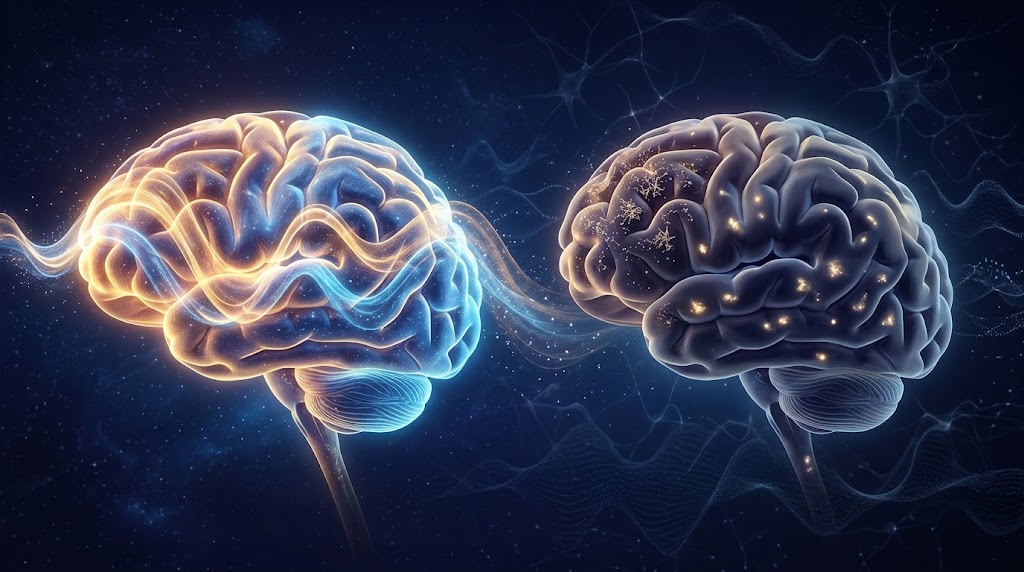
During deep sleep, huge groups of brain cells switch off and on together, creating slow waves that start at the front of the brain and sweep backward. These waves are thought to help lock in the memories we made during the day. Researchers at UC Berkeley recorded the sleeping brains of young adults in their early 20s and older adults in their 60s and 70s, and gave them word pairs to learn before bed and recall the next day. They also scanned the older adults for tau, an Alzheimer’s protein.
In older adults with more tau in the frontal cortex, the deep-sleep waves stopped traveling. Instead of sweeping across the brain in coordinated groups, they stayed small and isolated. The researchers called them “lonely waves.” People with more lonely waves remembered fewer of the word pairs the next morning.
“This is the first time we’ve shown this relationship between tau and how it messes with memory consolidation by attenuating traveling slow waves that originate in the frontal cortex,” said first author Omer Sharon, a postdoctoral researcher at UC Berkeley’s Center for Human Sleep Science.
None of these older adults had Alzheimer’s. Their memory was within the normal range for their age. “They had tau in their brains, but with subclinical impacts,” Sharon said. That suggests the link between tau, sleep and memory starts quietly, years before any diagnosis.
In younger adults, slow waves traveled together across a stretch of scalp roughly the width of a hand. In older adults, they traveled less far and fired more independently.
The team followed some participants for several years. In those whose frontal tau levels rose, the slow waves became less coordinated over time, and their ability to hold on to newly learned material overnight declined.
The work builds on earlier research from the same lab. In 2015, a study in Nature Neuroscience led by Bryce Mander and Matthew Walker found that amyloid, the other hallmark protein of Alzheimer’s, was linked to disrupted deep sleep and poorer overnight memory in older adults. The new study adds tau to the picture and shows how the waves themselves break down.
The second finding came from a separate group. Working with neurologist Yo-El Ju at Washington University in St. Louis, the researchers analyzed spinal fluid from other older adults. People with more lonely waves had higher ratios of tau to amyloid in their spinal fluid, the same pattern from a different method and a different group.
“We can see tau and lonely waves rising together over time,” Sharon said. “What we cannot yet say is which leads, and that question will shape how we design interventions.” Deep sleep keeps showing up as a window into the aging brain, alongside daytime napping and overall sleep quality.
There are limits to what this shows. The groups were small and the study is observational, so it cannot prove that tau causes the wave changes or that the waves cause memory loss. It may work the other way, or both may stem from something else. Sleep recordings and tau scans are research tools, not tests a person can easily get. The study was funded by the US National Institute on Aging.
Source
Sharon O, Chen X, Dude J, et al. “Human tau pathology is associated with lonely, nontraveling slow waves linked to memory impairment.” Nature Neuroscience, 2026.
DOI: 10.1038/s41593-026-02415-9
Also cited
Mander BA, Marks SM, Vogel JW, et al. “β-amyloid disrupts human NREM slow waves and related hippocampus-dependent memory consolidation.” Nature Neuroscience, 2015.
DOI: 10.1038/nn.4035