Scientists spent 30 years trying to find what carries Alzheimer’s from one brain cell to the next. A new study just identified it, and it turns out to be a protein the brain uses to carry memories

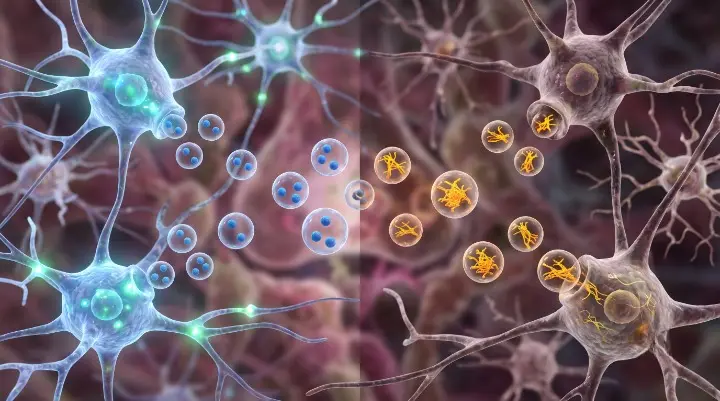
In a healthy brain, a protein called Arc has one of the more elegant jobs in neuroscience. When neurons need to send information to each other, Arc packages itself inside microscopic bubbles called extracellular vesicles and floats them across to neighboring cells, delivering molecular cargo that supports learning and memory. It is a system that evolution has conserved across species, efficient and reliable. Researchers have known about Arc for decades and generally regarded it as one of the brain’s most important communication tools.
A new study published in Cell has established that in a brain with Alzheimer’s disease, Arc is doing something else entirely. The same bubbles it uses to carry memory signals between healthy cells are being hijacked by toxic Tau protein and used as vehicles to carry the disease from sick neurons into healthy ones. When researchers removed Arc from Alzheimer’s mouse models, Tau spread dropped to almost nothing. The mystery of how Alzheimer’s progressively consumes the brain, a question that has resisted a definitive molecular answer for three decades, appears to have a central answer. The brain’s own communication system is the delivery mechanism.
What Tau does and why its spread matters
Tau is a structural protein found inside every neuron, where it stabilizes the internal scaffolding that keeps the cell’s transport system running. In a healthy brain, Tau is soluble and well-behaved. In Alzheimer’s disease, it begins to misfold and clump together into sticky tangles that block the neuron’s internal transportation networks and eventually kill the cell.
What makes Tau uniquely dangerous is not just its toxicity inside a single neuron but its ability to propagate. When Tau tangles build up inside a dying cell, they can break into smaller fragments called Tau seeds. These seeds, when transferred to a neighboring healthy neuron, corrupt that cell’s normal Tau protein, triggering a new cycle of tangle formation. The disease moves through the brain the way fire moves through dry forest: methodically, following the network.
Neurologists have understood this progression for decades. The staging system used to classify Alzheimer’s severity, developed by researchers Braak and Braak in the 1990s, maps exactly which brain regions Tau tangles invade and in what order, producing a predictable anatomical progression from memory regions outward that tracks closely with the worsening of clinical symptoms. What the field has not had, until now, is a clear molecular account of what carries Tau seeds from one neuron to the next.
“They glue together and block transportation within the neuron,” said first author Mitali Tyagi. “But they can break down into smaller glue monsters, called Tau seeds, which can then get transferred to a new neuron. And once this Tau seed comes into contact with healthy Tau, it is able to corrupt it. So, the pathology starts all over again in a healthy neuron.”
How Arc became a Trojan horse
Arc’s normal behavior already involves the extracellular vesicle system. Under ordinary conditions, Arc packages itself inside these membrane-bound bubbles and releases them from the neuron into the space between cells, where they can be taken up by neighboring neurons. The system is thought to play a role in synaptic plasticity, the process by which connections between neurons are strengthened or weakened based on activity.
The discovery the Utah team made is that Tau seeds can bind to Arc and get packaged into these same vesicles. From Tau’s perspective, it is an ideal arrangement: Arc is already running a delivery service to neighboring cells, the vesicles are already designed to be taken up by those neighbors, and the entire system operates continuously without requiring any modification. Tau does not need to develop a new mechanism to spread. It simply stows away on one that already exists.
In mouse models of Alzheimer’s disease, the researchers found that extracellular vesicles in affected brains contained both Arc and Tau. When those vesicles were delivered to healthy cells, they seeded new Tau tangle formation, starting the destructive cycle again in previously unaffected neurons.
To confirm Arc’s role directly, the team engineered Alzheimer’s model mice that lacked the Arc protein entirely. The effect was striking. In the absence of Arc, brain extracellular vesicles contained almost no Tau, and the capacity of those vesicles to seed disease in healthy neurons was eliminated.
“When we removed Arc, we saw that the transfer of Tau was severely, severely reduced,” Tyagi said. “It was almost gone.”
The double-edged sword that rules out the obvious treatment
The logical next step from a finding like this would be to develop a drug that blocks Arc, preventing it from packaging Tau into vesicles and halting the spread. The Utah team pursued that logic directly and found that it leads somewhere unexpected.
When Arc is absent and cannot package Tau into vesicles for export, the toxic protein builds up inside the sick neuron itself. With no way to eject the accumulating waste, the original diseased cell reaches toxic Tau concentrations far faster and dies significantly sooner than it would with Arc intact.
This creates a dilemma that makes Arc a uniquely difficult therapeutic target. With Arc functioning normally, Tau spreads to healthy cells but the original sick cell survives longer. With Arc blocked, the sick cell dies faster but fewer healthy cells get infected. Neither outcome is simply better than the other, and a drug that blocks Arc entirely may accelerate the death of already-damaged neurons while only partially addressing the spread.
“When Arc is absent, Tau becomes trapped inside neurons and accumulates to toxic levels. When Arc is present, Tau can be released in extracellular vesicles. While this helps reduce Tau buildup within the original neuron, the released Tau can be taken up by neighboring healthy neurons, promoting the spread of pathology,” Tyagi explained.
The mid-flight target
The dilemma points toward a more specific intervention. Rather than stopping sick cells from releasing Arc-containing vesicles, or attempting to block Arc function systemically, the researchers argue that the ideal therapeutic target is the vesicle itself after it has been released but before it reaches a healthy cell.
In the space between neurons, a Tau-containing extracellular vesicle is temporarily exposed. A drug designed to recognize and neutralize those specific vesicles in the extracellular space would interrupt the transmission of disease without interfering with Arc’s normal function inside the original neuron or preventing the export of toxic Tau that helps that cell survive.
“If we could target these particular EVs, that would be a really useful therapy strategy,” said senior author Jason Shepherd. “For someone with early-onset Alzheimer’s or dementia, if we could stop the spread, then we could prevent further damage and cognitive decline.”
Such a therapy would not reverse existing neuronal death. Neurons that have already been destroyed by Tau accumulation cannot be recovered. But for a patient in the early stages of Alzheimer’s, a treatment that freezes the disease at its current stage rather than allowing it to progress through the brain’s network could represent a meaningful and durable clinical benefit, preserving function that would otherwise be lost over the following years.
What the human tissue data adds
The mouse model findings would be significant on their own, but the research team added a critical validation step: they examined post-mortem brain tissue from human Alzheimer’s patients and found the same co-packaged Arc and Tau inside extracellular vesicles. Moreover, the amount of Arc in those human brain vesicles showed a strong positive correlation with the level of phosphorylated Tau in the same samples, a form of Tau strongly associated with disease severity.
The human data does not prove that the mechanism operates identically in people as in mice, and the researchers are explicit about that limitation. Mouse models of Alzheimer’s disease reliably produce Tau pathology but differ from human disease in important ways, and the translation from animal findings to human treatment has been the graveyard of many promising Alzheimer’s therapies.
What the human tissue data does establish is that the same molecular partnership the Utah team identified in mice, Arc and Tau co-packaged inside extracellular vesicles, exists in the brains of people who died with Alzheimer’s disease. The mechanism is real in human brain tissue. Whether blocking it in living human brains would slow the disease is the question that future clinical development will need to answer.
“Most of the work we’ve been doing is in mice, not in humans,” Shepherd said. “We have some clues that whatever is happening in these mice could also be happening in humans, but we don’t know that yet. And we’re far away from saying that we’re developing a treatment for anything. But it could open new avenues to get to that point.”
For 30 years, the question of how Alzheimer’s moves through the brain has been answered at the anatomical level but not the molecular one. Researchers knew where the disease went and in what order. They did not know what carried it. The Arc vesicle system is the first candidate with the experimental evidence to support it, confirmed in both mouse models and human tissue, with a specific intervention point already identified. The delivery mechanism has been found. Intercepting it is now the scientific and clinical challenge.
Source
Mitali Tyagi, Eric de Hoog, Matthew Grega, Kaelan R. Sullivan, Alicia C. Walker, Radhika Chadha, Ava Northrop, Balázs Fábián, Gerhard Hummer, Monika Fuxreiter, Bradley T. Hyman, Jason D. Shepherd. “Arc mediates intercellular tau transmission via extracellular vesicles.” Cell, June 29, 2026.
DOI: 10.1016/j.cell.2026.06.008