New research shows we can stop heart failure by preventing a specific genetic “protein clogging”

For decades, the medical consensus on heart attacks has been grim: once the muscle dies, it stays dead. Unlike a lizard that can regrow a tail, the human heart heals by forming stiff, non-functional scar tissue. This process, known as fibrosis, is the leading cause of chronic heart failure—a slow-motion catastrophe for millions.
But we just discovered the heart’s hidden “repair mode.”
A groundbreaking study published in the Proceedings of the National Academy of Sciences (PNAS) has identified a single enzyme—Retinol Saturase (RetSat)—that acts as the master regulator of cardiac recovery. Researchers from the University of Texas Southwestern Medical Center have revealed that by manipulating this enzyme, we can effectively “unclog” the heart’s metabolic engine and force it to heal correctly.
The Methodology: Hunting for the Repair Signal
To solve the mystery of heart repair, the research team analyzed the metabolic profiles of mice and human heart tissue following an injury. They specifically looked at the mitochondria—the “power plants” of the cell.
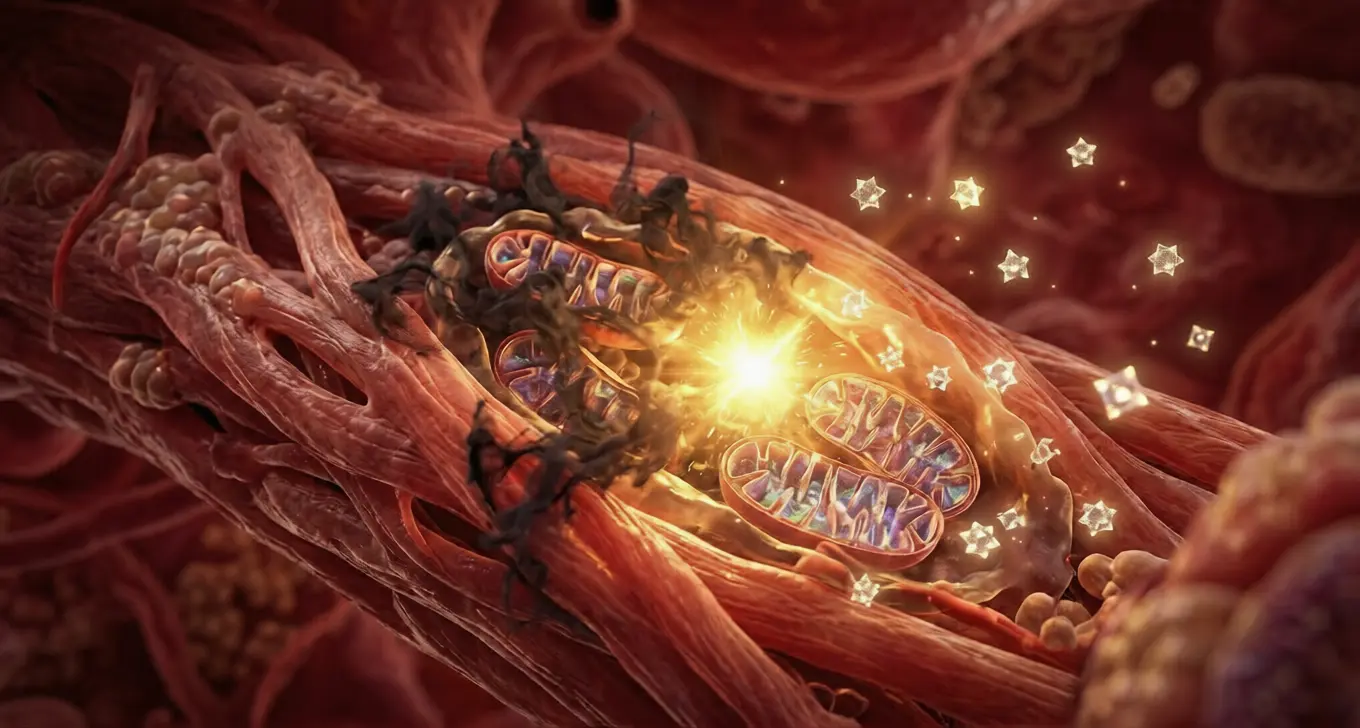
Using advanced proteomic mapping and mass spectrometry, the scientists tracked how proteins change shape after a heart attack. They discovered that in a failing heart, two critical metabolic engines (IDH2 and GLUD1) become “clogged” by a process called acetylation. Think of acetylation like rust on a piston; it slows down energy production right when the heart needs it most. The team then introduced RetSat to see if it could act as the “anti-rust” agent.
The Shock Factor: Reversing the “Irreversible”
The study’s “Shock Factor” lies in RetSat’s unexpected location and power. While it was previously thought to only handle Vitamin A in the cytoplasm, scientists found that after an injury, RetSat migrates into the mitochondria.
The results were revolutionary:
-
The Metabolic Cleanup: RetSat directly antagonizes (removes) the “rust” from IDH2 and GLUD1. This restores the heart’s ability to produce ATP—the cellular fuel required for muscle contraction.
-
Stopping the Scar: In subjects with high RetSat activity, the formation of deadly scar tissue was slashed by nearly 40%.
-
Survival Breakthrough: The study found that boosting RetSat levels allowed hearts that had suffered major “attacks” to recover almost full pumping function, whereas those without the enzyme plummeted into total heart failure.
The Science: The Vitamin Connection
RetSat is an enzyme that works with Retinoids (derivatives of Vitamin A). The research proves that heart repair isn’t just about blood flow; it’s about metabolic flexibility. By keeping the mitochondria clean, RetSat ensures the heart doesn’t “panic” after an injury and shut down. It provides the energetic “breathing room” the organ needs to rebuild muscle fibers instead of just patching the hole with scars.
The Life-Change Angle: How to Protect Your Pumping Engine
This discovery changes the trajectory of cardiovascular medicine. We are moving from “managing” heart disease to “curing” it at the mitochondrial level.
-
Targeted Supplementation Research: While you shouldn’t start megadosing Vitamin A (which can be toxic), this research opens the door for RetSat-activating therapies. Clinical trials may soon test compounds that mimic RetSat to protect high-risk patients.
-
The Mitochondrial Diet: To support your RetSat levels today, focus on mitochondrial health. Intermittent fasting and high-intensity interval training (HIIT) have been shown to naturally reduce protein acetylation, essentially pre-cleaning your heart’s engines before an injury occurs.
-
Future “Heart Armor”: Scientists envision a future where patients undergoing heart surgery receive a “RetSat boost” to ensure their recovery results in new muscle rather than a scarred, weakened organ.
-
Listen to the “Quiet” Signs: Heart failure starts with mitochondrial sluggishness. If you experience unexplained fatigue or shortness of breath, it’s a sign your “IDH2 and GLUD1” engines might be struggling. Early intervention with metabolic-focused lifestyle changes is now backed by hard genomic science.
We finally have the blueprint for a heart that can fix itself. The “mitochondrial repairman” has been found, and it’s time we gave it the tools to finish the job.