Scientists found that the fish oil supplement millions take for brain protection is actively slowing brain repair in a specific group of people

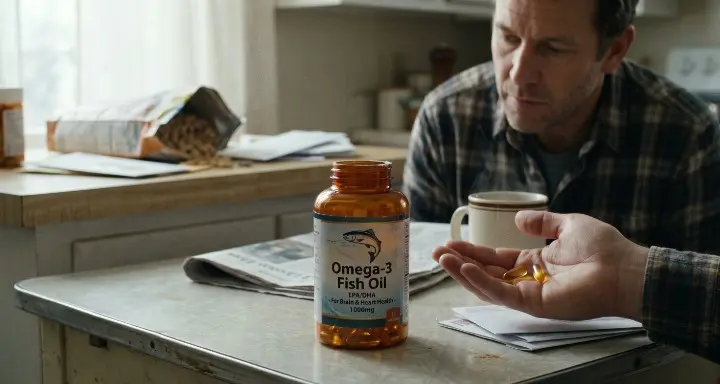
There is a bottle of fish oil capsules in roughly one in three American households. It sits next to the multivitamins, gets taken with breakfast, and carries a reputation as one of the safest, most evidence-backed supplements a person can take. Good for the heart. Good for the brain. Recommended by doctors. Marketed by everyone.
A study published in Cell Reports in March 2026 by researchers at the Medical University of South Carolina just put a significant crack in that reputation. Not for everyone. For a specific group that is far larger than most people realize.
If you have ever had a concussion, played contact sports, served in the military, experienced repeated falls, or work in a profession with regular head impact exposure, the fish oil you are taking to protect your brain may be doing something you were never warned about.
The Supplement That Wasn’t Supposed to Have a Dark Side
Fish oil contains two main omega-3 fatty acids: DHA and EPA. Most of the research that built fish oil’s reputation for brain health was done on DHA. It is incorporated directly into neuronal membranes, it supports synaptic function, and it plays a central role in the brain’s structural integrity. The evidence for DHA’s benefits in the brain is real and well-established.
EPA is the other one. It follows a different biological pathway. It is less incorporated into brain structures, and its effects turn out to depend heavily on what the brain is experiencing at the time. In a healthy brain at rest, EPA at normal dietary levels does not cause obvious harm. But put that same compound into a brain that is trying to repair itself after repeated mild traumatic injuries, and something changes.
The animals showed poorer neurological and spatial learning performance over time, together with clear evidence of vascular-associated tau accumulation in the cortex, linking impaired recovery to neurovascular dysfunction and perivascular tau pathology. Tau accumulation in the cortex is one of the defining features of chronic traumatic encephalopathy, the progressive brain disease found in former NFL players, boxers, soldiers, and anyone who has absorbed repeated impacts to the head over years. The researchers were not expecting to find it here.
What EPA Is Actually Doing After an Injury
The mechanism the MUSC team uncovered runs through the brain’s vascular repair system. After a mild traumatic brain injury, the neurovascular unit, the network of blood vessels that supplies the brain with nutrients and removes waste, needs to rebuild itself. Endothelial cells, the cells lining those blood vessels, have to form new networks, close wounds, and maintain the tight connections between them that keep the blood-brain barrier intact.
Only EPA reduced network formation, slowed wound closure, and weakened tight contacts between the cells. DHA did not do this. The effect was specific to EPA, and it only appeared when the cells were placed in conditions that encouraged fatty acid engagement, meaning conditions that mirror what happens in an injured brain actively trying to use available fuel sources for repair.
In the injured cortex, the team found something else. EPA triggered a coordinated shift in gene programs that normally support vascular stability and repair. Genes tied to extracellular matrix organization and endothelial integrity were suppressed. The brain’s repair machinery was being redirected away from rebuilding the vessels it needed.
And here is the part that makes this particularly unsettling: the damage was delayed. Early recovery after injury looked normal. It was months later that the same animals showed worsening movement and memory problems. If you were watching from the outside, you would have thought the fish oil was doing nothing at all. The problem was accumulating quietly underneath.
The Athlete in the Kitchen Every Morning
Think about who takes fish oil specifically for brain health. Athletes in contact sports, rugby players, footballers, martial artists, hockey players, who absorb repeated subconcussive impacts throughout their careers and take omega-3 supplements precisely because they have heard it protects their brain. Military veterans with histories of blast exposure. Weekend warriors who have had a few concussions over the years and want to protect what they have left.
These are exactly the people the MUSC study is describing. Not the general healthy adult population. The people who have already experienced the repeated mild traumatic brain injuries that create the sensitive brain state in which EPA appears to switch from neutral to actively harmful.
The researchers described the results as having implications for precision nutrition, therapeutic strategies and the design of dietary interventions targeting brain injury and neurodegeneration. That is careful scientific language for: the people who most need brain protection are possibly taking something that is working against them.
DHA and EPA Are Not the Same Thing
This is the distinction that most fish oil marketing never makes and most consumers never know to ask about. DHA and EPA are both omega-3 fatty acids. They are both in fish oil. They are usually listed together on supplement labels as a combined number. But they behave differently in the body, they have different biological roles, and they produce different outcomes in an injured brain.
DHA did not produce the neurovascular repair deficits the researchers observed. EPA did. The study found these effects were context-dependent, meaning that EPA is not a universal toxin and does not appear to cause harm in healthy brains under normal conditions. But under conditions of repeated mild traumatic brain injury, the biological environment of the brain changes in ways that make EPA’s presence damaging rather than benign.
Neuroscientist Onder Albayram, who led the study, put it plainly: if you are an athlete in a contact sport, a military service member, or anyone at elevated risk for repetitive mild traumatic brain injuries, this research gives us reason to pause and ask more questions. Not to panic. But to stop assuming that all omega-3 supplements are automatically brain-protective in all contexts.
The Problem With One-Size Nutrition
What this study is really pointing at is something the nutrition field has resisted accepting for a long time. The assumption that a supplement is either good or bad, protective or harmful, safe or dangerous, was always too simple. Biology is contextual. The same compound can support healing in one physiological state and interfere with it in another.
Fish oil built its reputation in research conducted on general populations, healthy adults, aging individuals, people with cardiovascular risk. That research is not wrong. But it did not ask what happens when the brain is in a specific, repeated-injury state that affects a very large number of real people who are taking the exact same supplement.
The next questions are already being asked. How is EPA taken up, transported, and distributed in the body after repeated head injury? Are there specific time windows post-injury when EPA is most harmful? Can targeted DHA supplementation provide the benefits people are seeking without the EPA-driven vascular disruption? These are answerable questions. They just have not been answered yet.
But they should have been asked before fish oil became the default brain supplement for every combat sport athlete and military veteran on the planet.
Source:
Karakaya, E., Berber, B., Eskiocak, O., et al. Eicosapentaenoic acid reprograms cerebrovascular metabolism and impairs repair after brain injury, with relevance to chronic traumatic encephalopathy. Cell Reports, March 25, 2026. DOI: 10.1016/j.celrep.2026.117135 https://www.cell.com/cell-reports/fulltext/S2211-1247(26)00213-5 https://www.musc.edu/content-hub/News/2026/03/25/musc-led-study-challenges-widespread-belief-about-fish-oils-effects-on-brain