Scientists found your memories of yesterday are likely a mathematical hallucination

Let’s start with the uncomfortable part. Statistically speaking, you are more likely to be a random accident than a real person with a real past. Your memories of this morning, your name, the feeling that you’ve lived a continuous life up to this exact moment — the math suggests all of it is more probably a fluke than the result of 14 billion years of cosmic history.
This isn’t a philosophical provocation. It’s a problem that has sat at the edge of physics for over a century, and a new paper published in the journal Entropy confirms we still haven’t solved it. Three researchers, David Wolpert, Carlo Rovelli, and Jordan Scharnhorst, have used some of the most rigorous probability theory available to show that our escape from this nightmare depends entirely on an assumption we never consciously agreed to make.
What a Boltzmann brain actually is
The setup goes like this. Given enough time, a universe in thermal equilibrium will eventually produce every possible arrangement of matter through random fluctuation alone. Every single one. Including a fully formed human brain, floating in empty space, wired with fake memories of a life that never happened.
Here’s the statistically brutal part. Building that one brain is astronomically easier for the universe than constructing an entire cosmos with a low-entropy Big Bang at the start, billions of years of structure formation, a solar system, a planet, and then you. The shortcut is almost always cheaper. Which means, if you’re being honest with the math, the random brain is far more likely than the real one.
The standard pushback has always been that this reasoning collapses under its own weight. If you’re a Boltzmann brain, you can’t trust the laws of physics you used to conclude you’re a Boltzmann brain. It’s a snake eating its own tail. Philosophers have called it unstable reasoning and moved on. The Santa Fe Institute team didn’t move on.
The thing physics never actually told us
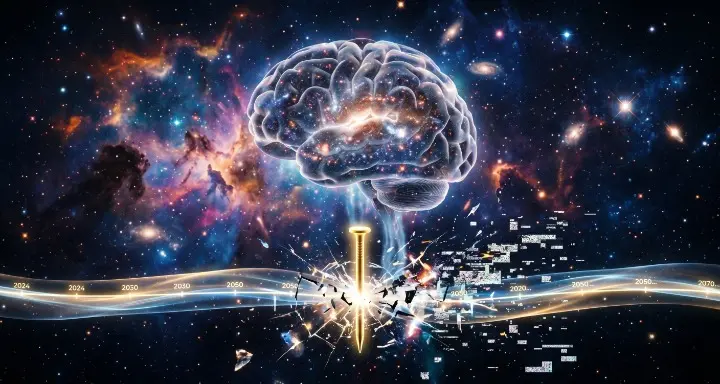
What Wolpert and his colleagues focused on is something called the Past Hypothesis. This is the assumption, baked into almost all of modern physics, that the universe began in a specific low-entropy state. We call it the Big Bang. We treat it as the starting nail, the fixed point from which entropy has been climbing ever since, giving us the arrow of time, the reliability of memory, the whole story.
Their paper shows that the Past Hypothesis and the Boltzmann Brain Hypothesis are, mathematically, the same kind of move. Both take a stochastic process, meaning a system governed by probability rather than certainty, and pin it to a single moment in time. Both say: here, at this specific point, entropy had this specific value. Everything else follows from there.
If you pin the Big Bang, you get the Second Law of Thermodynamics and a universe with a coherent past. If you pin the present moment instead, you get a Boltzmann brain with convincing fake memories and no real history behind it. Physics itself does not tell you which pin is correct. That part is on us.
The year 1000 problem
To show how arbitrary this all is, the researchers introduced what they call the 1000 CE hypothesis. Imagine the universe existed in total chaos until the year 1000 AD. At that exact moment, a massive random fluctuation produced a low-entropy pocket of reality, complete with a medieval world, plausible backstory, and everything that has followed since.
Under this model, your history books would still be accurate. Your experiments would still work. The Second Law would hold perfectly for the last thousand years. But everything before 1000 AD, the Roman Empire, the pyramids, the dinosaurs, would be fabricated. A story the fluctuation came pre-loaded with.
The point isn’t that this is true. The point is that nothing in the equations rules it out. You can keep sliding that starting point forward in time as far as you want, and the math stays valid. The only reason we anchor ourselves to the Big Bang is our cosmological observations, and even those, the researchers quietly note, are being interpreted through the very assumptions we’re trying to justify.
Where the Second Law starts to bend
When you stop picking just one anchor point and instead nail the equations to two moments simultaneously, the Big Bang and the present, something strange happens to the Second Law itself.
It holds on long timescales. But up close, in the very recent past, entropy doesn’t behave as cleanly as the textbook version suggests. It may actually tick upward as you approach the present from just moments before. The law doesn’t break, but it softens. The researchers call this the attenuated version, a more complicated truth that our standard model has been smoothing over.
This at least rules out the floating brain scenario. But it replaces it with something almost equally strange: the possibility that the Second Law as we currently teach it is a useful approximation of something messier and less absolute.
What you’re actually choosing when you trust your memories
The paper ends somewhere that feels less like physics and more like something you’d turn over in your head at 2am. Your belief that the past was real is not something the equations hand you. It’s a prior. A choice. You’ve decided, without being fully aware of it, to trust your memories and your records and your lab notebooks as reliable evidence of a continuous history.
That’s not irrational. It’s the only way to function. But Wolpert, Rovelli, and Scharnhorst are pointing out that the circularity runs deep. You need the Second Law to explain why memory is reliable. You need reliable memory to believe the Second Law is real. Neither one holds up the other from outside the system.
The universe, in their framing, is just probability shuffling itself across infinite time. We are a sequence that happened to become self-aware for a moment, reading patterns into cards that may or may not have been dealt from a real deck. Whether there’s a genuine 14-billion-year story behind us, or just the convincing appearance of one, comes down entirely to where you decide to put the nail.