A study of 4,523 people with dementia found that those who were overweight or obese at diagnosis had a lower risk of dying than people of normal weight. The usual statistical explanations for this paradox did not hold up.

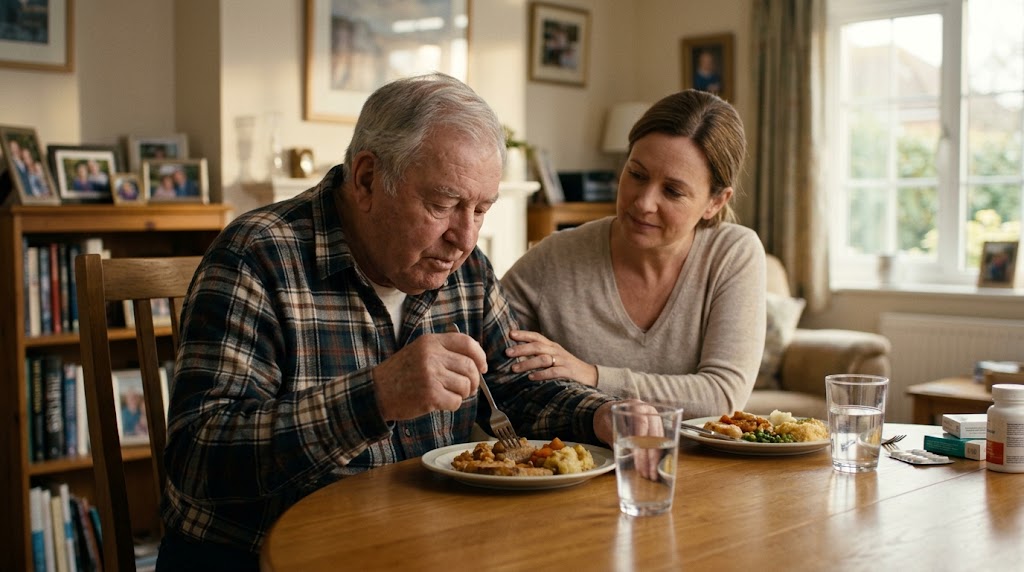
Most of us spend our adult lives hearing that extra weight shortens life. For people who already have dementia, a handful of studies have hinted at the opposite, and many researchers have suspected a statistical trick. A team from Columbia University and New York University went back to 24 years of data on older Americans and picked out 4,523 people who developed dementia along the way. Then they tested every explanation for the paradox they could think of.
Weight at the time of diagnosis tracked closely with survival. Compared with people in the normal weight range, those who were overweight had a 16% lower risk of dying during follow-up. People with obesity (a BMI of 30 to 34.9) had a 27% lower risk, and those with more severe obesity had a 22% lower risk.
In other words, the obesity paradox in dementia showed up again, and this time it survived the tests designed to explain it away.
The result runs against most of what we know about weight. Obesity raises the risk of heart disease and diabetes, and extra weight in midlife is linked to a higher risk of developing dementia in the first place. As we reported last week, belly fat in midlife was linked to Alzheimer’s proteins in the blood decades later, although that pattern flipped after age 70.
The main reason to doubt the obesity paradox is weight loss before diagnosis. Dementia can start eroding appetite and body weight years before anyone names the disease. A 2018 analysis of 1.3 million people in Alzheimer’s & Dementia showed how this distorts results: weight measured close to diagnosis made obesity look protective, while weight measured decades earlier showed it raising dementia risk.
That is the trap this study set out to avoid. The data came from the Health and Retirement Study, which has followed US adults aged 51 and older since the 1990s. Everyone included was free of dementia when they joined, so the researchers could see each person’s weight years before diagnosis, at diagnosis, and afterward.
“Because this finding is somewhat counterintuitive, an important question is whether it could simply be an artifact of bias,” corresponding author Yuan Zhang of Columbia said in a statement.
The team tested three of the usual suspects. They accounted for weight lost before diagnosis, for a statistical distortion that can arise when only people who develop a disease are studied, and for survivor bias, the possibility that people with obesity who live long enough to develop dementia are unusually tough. None of these explained the survival gap.
“Our analyses suggest that the major sources of bias we examined do not explain the survival advantage associated with higher weight,” Zhang said.
The authors’ best guess for the obesity paradox is reserves. People with advanced dementia often lose their appetite, struggle to feed themselves and waste away. “Nutrition can be a big problem for people with dementia,” said first author Virginia Chang of NYU, pointing to changes in the brain’s drive to eat and in energy use.
Extra weight may give the body something to draw on during infections, illness or long stretches of eating too little. The study did not test that directly.
None of this means anyone should try to gain weight. “This doesn’t mean that patients with dementia should attempt to become overweight or obese, as our study was not designed to test that question,” Chang said. For families, the more useful takeaway is about weight loss: if someone with dementia is steadily losing weight, that is worth raising with their doctor. Researchers are also rethinking other long-held assumptions about dementia risk, such as the old warning about hormone therapy.
There are limits to what this shows. The study is observational, so it cannot prove that weight itself protects anyone. BMI is a blunt measure that does not separate fat from muscle, and some of the benefit may come from muscle and general strength rather than fat.
The results are relative risks, and the summary does not report how many people died in each weight group. The sample was American, and the findings may differ elsewhere. The authors suggest using weight at diagnosis as one signal of how a person may fare, alongside other factors, not as a target.
The study was funded by the National Institutes of Health.
Source
Chang VW, Hayes-Larson E, Zheng H, Zhang YS. “Body mass index and mortality in incident dementia.” Journal of Alzheimer’s Disease, 2026.
DOI: 10.1177/13872877261491694
Also cited
Kivimäki M, Luukkonen R, Batty GD, et al. “Body mass index and risk of dementia: Analysis of individual-level data from 1.3 million individuals.” Alzheimer’s & Dementia, 2018.
DOI: 10.1016/j.jalz.2017.09.016