Coffee calories in America have jumped nearly 40% in 15 years even though people drink the same amount, and sugar isn’t the main reason

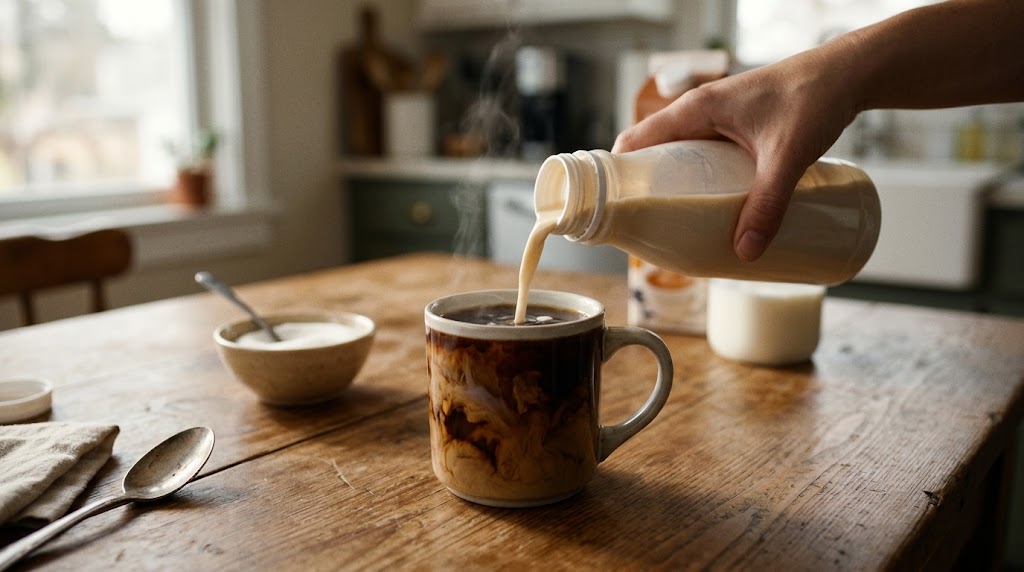
Americans drink about the same amount of coffee today as they did twenty years ago, roughly 13 ounces a day. But researchers at Tufts University noticed something had changed in the cup. They went through the dietary records of 30,459 adults collected by a national health survey between 2003 and 2018, tracking not just the coffee but everything people stirred into it. The calories had climbed, and the reason was not the one most people would guess.
The average number of calories Americans got from coffee rose from 43 to 60 a day, an increase of nearly 40%. The main driver was not sugar. It was non-dairy creamer.
By 2018, non-dairy creamer added 18.5 calories a day to the average coffee drinker’s intake, compared with 16 from sugar and syrup and 11 from dairy milk. In 2003, creamer had added just 7.7 calories a day. For coffee calories, creamer had quietly overtaken both sugar and milk.
“We found that non-dairy creamer being added to coffee has now passed both sugar and dairy for its contribution to the total energy consumed from coffee,” lead author Yongyi Pan of Tufts’ Friedman School of Nutrition Science and Policy said in a statement. “Non-dairy creamers can be high in saturated fat, which is calorie dense.”
The amounts tell the story. Average non-dairy creamer use more than doubled, from 3.4 grams a day in 2003 to 8 grams in 2018. Non-dairy milks such as oat and almond also rose sharply, from 0.27 to 2.45 grams a day. Dairy milk was still the most common addition by weight, at 21.4 grams a day, and neither milk, sugar nor sugar substitutes changed much over the period.
Pan suggests that creamer’s popularity has grown as people look for plant-based or dairy-free options, even though it has been on supermarket shelves since the 1950s.
The data come from the National Health and Nutrition Examination Survey, a nationally representative study in which each participant reports everything they ate and drank over two separate days. The team split coffee drinks into plain coffee and coffee with additions, then sorted the additions into milk, cream, creamer, non-dairy milk, sugar, sweeteners and others, estimating the contents of pre-mixed drinks from the US Department of Agriculture’s food database.
The second finding is about who drinks the most. People who slept fewer hours drank more coffee than those who slept longer, and people who worked longer hours drank more than those with shorter schedules. Coffee intake did not differ much between people with healthier and less healthy overall diets.
Seventeen extra calories a day is not much on its own. Over a year it adds up to roughly 6,000 calories, and for people who drink several cups or use flavored creamers generously, the real number can be far higher. Checking the label on a creamer is an easy place to start. Coffee itself has some intriguing health links, as research on coffee and the gut suggests, and the bigger question of how processing changes food is still unfolding, as a recent 19-year study of ultra-processed food showed.
There are limits to what this shows. The data rely on people remembering what they ate and drank, which can be inaccurate, and two days of recall may not reflect usual habits. The survey ends in 2018, before more recent shifts in coffee culture, and it describes trends rather than health effects.
Source
Pan Y, Zhou B, Zhang FF. “Trends in the Consumption of Coffee and Coffee Additions Among U.S. Adults Aged 20+ Years, The National Health and Nutrition Examination Survey 2003–2018.” Journal of the Academy of Nutrition and Dietetics, 2026.
DOI: 10.1016/j.jand.2026.156908