Wyoming fossil hunters call them squid butts. Scientists have described the fattest one ever found, from a family thought to be long gone

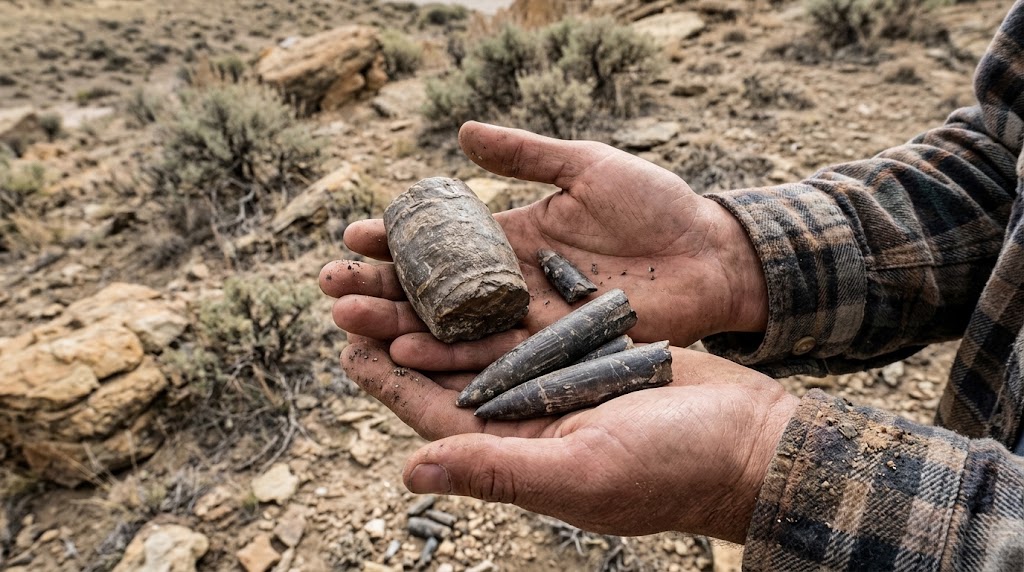
In Wyoming, fossil hunters pick up belemnites by the handful. These bullet-shaped stones are the hard back ends of ancient squid relatives, so common that locals call them squid butts. In the late 1990s, a museum founder picked up one that looked wrong: far too thick. It sat in a drawer for years, until a second one turned up and an international team finally took a closer look.
It turned out to be a new species, and the chunkiest belemnite ever found. Most belemnites from Wyoming are slim, about 5 to 10 centimeters long and only 1 to 2 centimeters wide. The new one is about 10 centimeters long but up to 6 centimeters wide, shaped more like a barrel than a bullet.
The researchers named it Wyoteuthis linsterorum, which roughly means a squid from Wyoming, honoring the family of Cliff Linster, the fossil collector who found the second specimen near Ten Sleep and donated it in 2019. It lived about 160 million years ago, in the Jurassic, when a shallow inland sea covered much of the western United States.
Belemnites were close cousins of today’s squid and cuttlefish. They had ten arms with hooks and a hard internal skeleton, and the bullet-shaped part that fossilizes, called the rostrum or guard, sat at the back end of the animal. They swarmed through ancient oceans for well over 100 million years before vanishing around the time the dinosaurs did.
“After spending years fossil hunting in Wyoming and collecting countless fossils of the common Pachyteuthis belemnites here in Wyoming, this one is unlike anything I have ever seen!” said co-author and paleontologist Jessica Lippincott.
The second surprise came from inside the fossils. CT scans revealed internal structures that link Wyoteuthis to a family of belemnites thought to have disappeared millions of years before it lived. The team describes it as a relict, a late survivor of a group that had otherwise faded out, which is why the paper calls it a relict megateuthidid.
Its size may hint at its lifestyle. The researchers estimate that the whole animal could have reached about 60 centimeters from the tips of its arms to the back of its body, and suggest it may have hunted smaller belemnites, its own more common relatives.
Wyoming paleontologist Bill Wahl, who started the project, said the fossil “stuck out like a sore thumb” among the thousands of ordinary specimens. He brought in belemnite specialist Alexey Ippolitov, now at Victoria University of Wellington in New Zealand, along with British palaeontologist Dean Lomax.
Both specimens are on display at the Wyoming Dinosaur Center in Thermopolis. Stories like this are a reminder of how much still sits unstudied in museum drawers. The same was true of the Homo erectus fossils from a South African cave that waited decades for a full description.
There are limits to what two fossils can show. The new species is known only from the hard back end of the animal, so its full body shape, its length and its diet are estimates based on related species. The link to the older family rests on internal features visible in the scans, and more specimens would help confirm it.
Source
Ippolitov AP, et al. “The Big Chunky Belemnite: a new relict megateuthidid from the Oxfordian (Late Jurassic) of Wyoming, USA, and its place in the evolutionary history of the group.” Papers in Palaeontology, 2026.
DOI: 10.1002/spp2.70123