A study of 2,316 burials spanning 6,000 years in China found that inequality became entrenched long before the first states existed. Farming, the usual suspect, did not explain it.

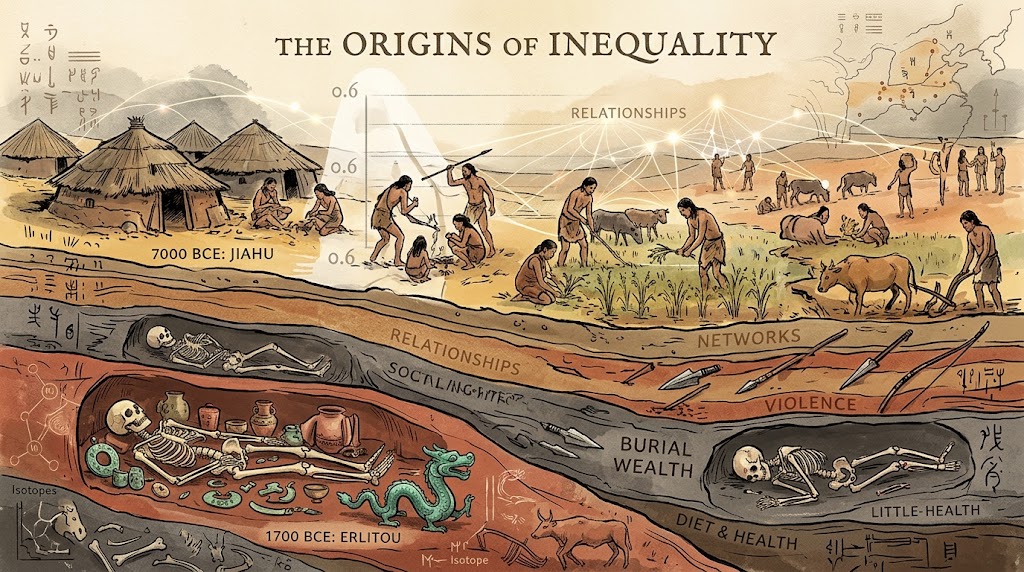
The textbook story of inequality goes like this: people farmed, farming produced surpluses, surpluses produced owners, and owners eventually built states and kings. Researchers in China tested that story against the dead. They pulled together records of 2,316 burials from 24 sites on the Central Plain, the heartland of early Chinese civilization, covering 6,000 years from 7000 to 1500 BCE. What the graves showed did not fit the textbook.
Deep inequality was there long before the first states, and it was not driven by farming. Differences in burial wealth, health and diet appeared early and became entrenched over thousands of years. The researchers found that neither the spread of agriculture nor the size of the population could explain who ended up with more.
What did explain it, they argue, was relationships. People held different positions in social networks, and those positions controlled access to labor, scarce goods, food and ritual objects. When states finally appeared, they did not invent inequality. In the authors’ words, early states “stabilized rather than created these pre-existing disparities.”
That challenges a long line of thinking that ties inequality to agriculture. A 2017 study in Nature compared house sizes at 63 archaeological sites around the world and found that wealth gaps grew far larger in Eurasia than in the Americas after farming took hold, which the authors linked to domesticated animals that could plow fields and pass wealth between generations. The new study does not throw that out. Livestock and other movable wealth also show up in the Chinese record as forces that hardened inequality. But they arrive after the gaps were already there.
The earliest example is the most striking. At Jiahu, a village of semi-underground houses where people lived mostly by hunting and gathering, with some early rice, the burials already show sharp differences between people. According to coverage of the paper, the study assigns Jiahu a Gini coefficient of about 0.6. The Gini coefficient is the standard measure of inequality, where 0 means everyone has the same and 1 means one person has everything.
To build the picture, the team combined several kinds of evidence. Grave goods showed burial wealth. Chemical isotopes in bones showed what people ate. Skeletons showed signs of illness, poor nutrition and injury. Animal remains showed what was being herded and hunted.
The second finding is about violence. As the centuries passed, signs of violent conflict became more common, and inequality grew sharper alongside them. The researchers write that violence appears to have contributed to “the amplification and structuring of inequality,” while noting that the arrow could also run the other way.
By the time of Erlitou, a site often linked to China’s first state around 1700 BCE, elite tombs held rare ritual objects such as a dragon made of turquoise pieces. The authors argue that this concentration of ritual, military and political control grew out of networks that had been unequal for millennia.
The researchers also stress that “no single pathway led to persistent inequality across early centers of social complexity.” What happened on the Central Plain may not be what happened in Mesopotamia, Egypt or the Americas.
There are limits to what this shows. The study reanalyzes burials that were excavated and published by many teams over decades, so methods and record-keeping vary between sites. Graves capture how people were buried, which reflects the living but is not the same as their wealth in life. Who was given a formal burial at all may itself have depended on status, which could leave the poorest people out of the record.
Source
Li D, Guo S, Chen X. “How inequality became durable before states: Evidence from 6,000 years in the Central Plain of China.” Science Advances, 2026.
DOI: 10.1126/sciadv.ady6737
Also cited
Kohler TA, Smith ME, Bogaard A, et al. “Greater post-Neolithic wealth disparities in Eurasia than in North America and Mesoamerica.” Nature, 2017.
DOI: 10.1038/nature24646