New research found that the chronic brain inflammation responsible for memory decline can be reversed with two doses of a nasal spray derived from human neural stem cells

Brain aging has always been framed as a one-way process. Neurons accumulate damage. Inflammation builds. The hippocampus shrinks. Connections weaken. Medicine has offered ways to slow this progression through lifestyle interventions, and more recently through drugs targeting specific pathological proteins like amyloid and tau. What it has not offered, until now, is a way to reverse the inflammatory state that underlies the decline itself.
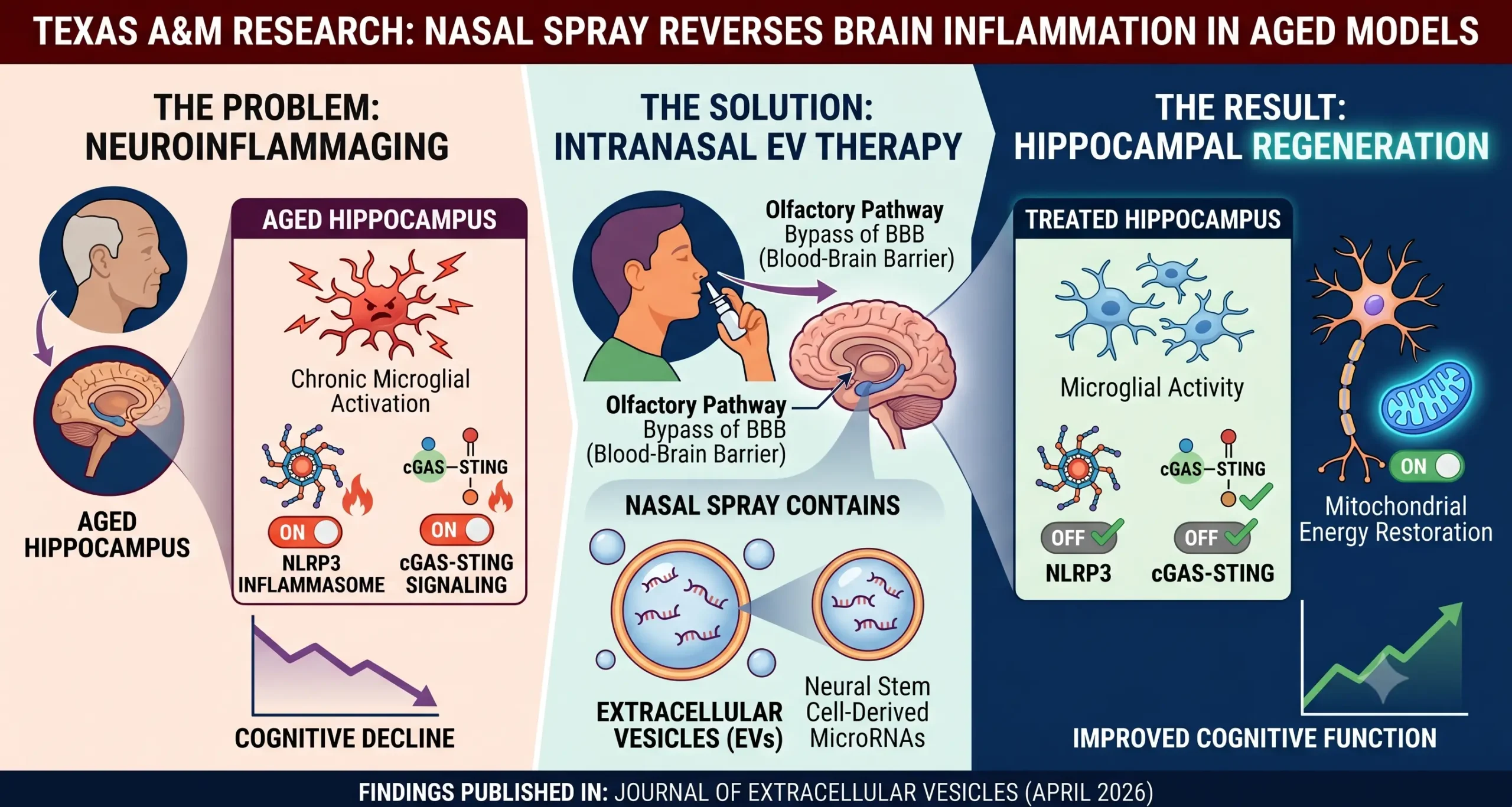
Researchers at Texas A&M University’s Naresh K. Vashisht College of Medicine, led by Dr. Ashok Shetty, distinguished professor and associate director of the Institute for Regenerative Medicine, have developed a nasal spray that does exactly that in aged animal models. Two doses. Weeks to take effect. The benefits lasted for months. The hippocampus, the brain’s memory center, showed measurably reduced inflammation, restored cellular energy, and significantly improved function on cognitive tests. The team has filed a patent and is moving toward human trials.
The findings were published in the Journal of Extracellular Vesicles in April 2026, funded by the National Institute on Aging.
The Problem the Spray Was Designed to Fix
The Texas A&M team built their research around a concept they call neuroinflammaging, a slow, chronic, low-grade inflammation that builds in the aging brain over decades and sits at the root of the cognitive decline most people associate with getting older. This is not the dramatic acute inflammation of a brain injury or an infection. It is a persistent smoldering in the brain’s immune cells, called microglia, that gradually disrupts the hippocampus’s ability to form memories, adapt to new information, and maintain the cellular energy systems that keep neurons functioning.
Microglia are the brain’s resident immune cells. In a young brain, they survey the tissue constantly, clearing cellular debris and responding to threats before withdrawing back to a resting state. In an aging brain, this withdrawal becomes incomplete. Microglia get stuck in a state of chronic low-level activation, releasing inflammatory signals continuously and disrupting the molecular environment of the hippocampus. The NLRP3 inflammasome and the cGAS-STING signaling pathway, both identified in the Texas A&M study, are two specific molecular mechanisms through which this chronic microglial activation drives neuroinflammation and accelerates cognitive decline.
These pathways are not peripheral to brain aging. They are central to it. NLRP3 activation has been found in post-mortem Alzheimer’s brain tissue. cGAS-STING signaling is emerging as a key driver of age-related neuroinflammation across multiple neurodegenerative conditions. The Texas A&M team chose these pathways as their targets because inhibiting them means addressing the fire rather than treating symptoms of the smoke.
What the Nasal Spray Contains
The delivery mechanism is what makes this approach different from previous attempts to calm neuroinflammation. The spray does not contain a drug in the conventional sense. It contains extracellular vesicles, microscopic particles derived from human neural stem cells, that carry a specific cargo of microRNAs into the brain through the nasal passage.
Extracellular vesicles are naturally occurring communication packages that cells use to send molecular signals to neighboring cells. Neural stem cell-derived vesicles carry a distinctive payload of regulatory molecules that reflect the stem cells’ role in maintaining and repairing neural tissue. When these vesicles are delivered intranasally, they travel from the nasal mucosa along the olfactory pathway directly into the brain, bypassing the blood-brain barrier that blocks most drugs from reaching neural tissue.
Once inside the hippocampus, the microRNAs carried in the vesicles do two things simultaneously. They switch off the molecular signals driving chronic microglial inflammation, specifically inhibiting NLRP3 and cGAS-STING activity. And they restore the mitochondrial energy systems in neurons that chronic inflammation had been suppressing, essentially restarting the cellular power plants in the memory center. The anti-inflammatory effect and the energy restoration effect work together, removing the brake on hippocampal function while simultaneously refueling the neurons whose performance was being dragged down.
What Happened to the Aged Mice
The experimental subjects were 18-month-old mice, an age equivalent to roughly 60-year-old humans in terms of biological aging stage. They received two intranasal doses of the extracellular vesicle treatment. The researchers then tracked them over the following months using multiple behavioral and molecular measurements.
Compared with untreated aged mice, the treated animals showed dramatically reduced markers of brain inflammation in the hippocampus. The NLRP3 and cGAS-STING pathways were measurably suppressed. Microglial activity profiles shifted from the chronic inflammatory state characteristic of aging brains toward patterns more resembling younger animals. The cellular energy supply in hippocampal neurons improved.
On cognitive tests, the treated mice performed significantly better than untreated controls on recognition of familiar objects, detection of environmental changes, and adaptation to new spatial information. These are not trivial behavioral metrics. Object recognition and spatial adaptation depend on hippocampal function and are among the first capabilities to degrade as Alzheimer’s pathology develops in both mice and humans.
The benefits appeared within weeks of treatment and persisted for months following only two doses. “We are seeing the brain’s own repair systems switch on, healing inflammation and restoring itself,” Shetty said.
Why the Nasal Delivery Route Changes Everything
Getting therapeutic agents into the brain has been one of the central engineering problems of neuroscience for decades. The blood-brain barrier is extraordinarily selective, blocking entry to most molecules based on size, charge, and chemical properties. Most drugs that show promise in vitro or in animal models fail to produce equivalent effects in humans partly because adequate concentrations cannot be achieved in brain tissue without doses that produce systemic toxicity elsewhere.
The intranasal route bypasses this problem entirely. The olfactory nerve provides a direct anatomical pathway from the nasal cavity to the olfactory bulb and from there to broader brain structures. Extracellular vesicles delivered this way reach hippocampal tissue without entering systemic circulation at the concentrations required for effect, which also reduces the likelihood of systemic side effects that complicate many neurological drug candidates.
The use of human neural stem cell-derived vesicles rather than synthetic compounds or small molecule drugs adds a layer of biological compatibility that makes the approach particularly attractive. The vesicles are not foreign to the brain’s molecular environment. They carry the same category of signals that the brain’s own stem cells use for communication and repair. The treatment is, in a meaningful sense, giving the aging brain a concentrated version of the molecular conversation its own stem cells conduct.
What Still Needs to Happen
The researchers are explicit about where the research stands and what remains to be done. The findings are in aged mice. Human brains are more complex, human aging is more variable, and the translation from promising animal results to effective human therapies has failed more often than it has succeeded in the history of neuroscience.
The team is filing a patent for the nasal spray and working toward developing a version for human trials. Safety studies, dose optimization, and establishing the manufacturing processes required to produce consistent batches of human neural stem cell-derived extracellular vesicles at scale are all steps that precede any clinical trial. None of this is fast. A realistic timeline from the current animal data to a completed human clinical trial is measured in years rather than months.
What the Texas A&M study does establish, with the specificity that moves a finding from speculative to scientifically grounded, is that the inflammatory state driving hippocampal aging can be reversed rather than merely slowed. The molecular pathways maintaining that state can be inhibited. The cellular energy systems it was suppressing can be restored. And the cognitive improvements that result from doing these two things simultaneously are measurable, durable, and produced by a delivery mechanism simple enough that a person could administer it themselves.
The question the research has answered is whether brain aging can be reversed at the level of the underlying inflammatory biology. The answer from two doses of a nasal spray in aged mice is yes. The question it has opened is whether the same answer holds in an aging human hippocampus.
Sources:
Madhu, L.N., Kodali, M., Rao, S., Attaluri, S., Upadhya, R., Shankar, G., Shuai, B., Somayaji, Y., Ganesh, S.V., Kumar, V.S., James, J.E., Shetty, P.A., LeMaire, A., Rao, X., Cai, J.J., Shetty, A.K. Intranasal Human NSC-Derived EVs Therapy Can Restrain Inflammatory Microglial Transcriptome, and NLRP3 and cGAS-STING Signalling, in Aged Hippocampus. Journal of Extracellular Vesicles, 2026; 15(2): e70232. DOI: 10.1002/jev2.70232
stories.tamu.edu/news/2026/04/14/scientists-reverse-brain-aging-with-a-nasal-spray