A study of 747 Norwegian children found that their own screen time was mostly not linked to slower vocabulary growth from age 5 to 7. The screen that mattered belonged to someone else.

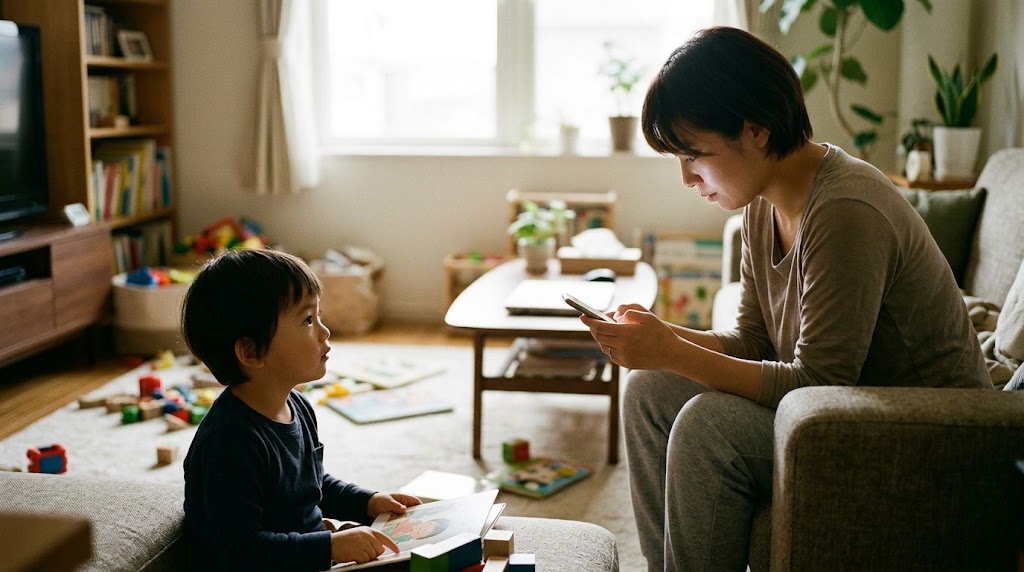
Most parents who worry about screens worry about their children’s screens: the tablet at dinner, the cartoons before bed. Researchers in Norway decided to measure every screen in the house. They followed 747 children from about age 5 to 7, testing how many words each child understood every year, and recorded the kids’ screen time, whether they owned a device, and how much their parents used social media and their phones. Only one of those screens tracked with slower progress.
It was the parent’s smartphone. For every extra hour a day the main parent spent on their phone, the child’s understanding of words grew more slowly from year to year. Most measures of the children’s own screen time, by contrast, showed no link with how fast their language developed.
In numbers, each extra daily hour of parent phone use went with growth in the child’s vocabulary score that was 0.42 points slower per year. That is a modest effect per hour, but it adds up for a parent who spends three or four hours a day on their phone. When it comes to parents’ smartphone use and children’s language, the parent’s habits seemed to matter more than the child’s.
That fits a growing body of research on what scientists call technoference, when devices interrupt the back-and-forth between parent and child. A 2024 Australian study in JAMA Pediatrics used audio recorders worn by toddlers and found that more screen time in the home meant fewer words spoken to children and fewer conversational turns between parent and child.
Other studies have focused on the children’s screens. A 2023 study of 57,980 Japanese children linked more TV and DVD time at ages 1 and 2 to lower developmental scores a year later. The Norwegian results suggest that by age 5, the picture may shift toward what the adults are doing.
The children were recruited through municipalities across Norway in 2023 and tested each year on receptive vocabulary and grammar, meaning how many words and sentence structures they understand. Parents reported the child’s daily screen time, whether the child owned a tablet or phone, each parent’s social media use, and the main parent’s own smartphone screen time. The analysis took parental education and household income into account.
The second finding concerns children who owned a device. Kids who already had their own tablet or phone at age 4 to 5 scored about 5 points lower on vocabulary and 4.6 points lower on grammar at the start of the study. But owning a device was not linked to slower growth after that. The gap was there from the start and did not widen.
“These findings highlight the importance of considering screen use within the broader family context when evaluating children’s language development,” the researchers write.
For parents, the practical point is about attention, not guilt. Children learn words from conversation, and every hour spent looking at a phone is an hour with fewer chances to talk, read or answer questions. Putting the phone away during meals, play and bedtime routines is the simplest change the findings point to. Screen research keeps finding that context matters, as with a recent twin study on teens and depression and research showing young children may be most sensitive at specific ages.
There are limits to what this shows. The study is observational, so it cannot prove that parents’ phone use slows their children’s vocabulary. Parents who spend more time on their phones may differ in other ways, such as stress, work hours or how much they read with their children, that the analysis could not fully capture.
Screen use was reported by parents, which can be inaccurate, and the study did not record what parents were doing on their phones. The effect per hour was modest, the children were followed for only about two years, and the results come from Norway, where family life and childcare differ from many other countries.
Source
Yang J, Furnes BR, Morken F, et al. “Screen use and children’s language development from ages 5 to 7 years.” JAMA Pediatrics, 2026.
DOI: 10.1001/jamapediatrics.2026.3490
Also cited
Japan Environment and Children’s Study Group. “Screen time and developmental performance among children at 1-3 years of age in the Japan Environment and Children’s Study.” JAMA Pediatrics, 2023.
DOI: 10.1001/jamapediatrics.2023.3643
Brushe ME, Haag DG, Melhuish EC, et al. “Screen time and parent-child talk when children are aged 12 to 36 months.” JAMA Pediatrics, 2024.
DOI: 10.1001/jamapediatrics.2023.6790