Roger Penrose proposed in 1969 that energy could be pulled out of a spinning black hole. A lab in New York just proved he was right

In 1969, Roger Penrose proposed something that sounded closer to science fiction than physics. He described a process by which energy could be pulled directly out of a rotating black hole. The idea was mathematically elegant: near a spinning black hole exists a region called the ergosphere, where the black hole’s rotation drags spacetime itself along with it. Penrose showed that if a particle entered the ergosphere and split in two, with one fragment falling into the black hole and the other escaping, the escaping piece could carry away more energy than the original particle brought in. The black hole would lose a tiny amount of its rotational energy. The universe would gain energy from one of the most extreme objects in existence.
A few years later, Soviet physicist Yakov Zel’dovich extended the idea. Not just particles, he argued, but waves could also extract rotational energy from a sufficiently fast-spinning body and emerge amplified. The catch was that the required rotational speed was extreme, faster than any physical object could realistically be made to spin, which meant the prediction, while compelling in theory, had no experimental path forward.
That was the situation for five decades. A new paper published in Nature by researchers at the CUNY Graduate Center in New York has now changed it. Not by building a faster spinner, but by building something that behaves as though it is spinning at those extreme speeds without actually rotating at all.
The device that simulates the impossible
The challenge in testing the Penrose-Zel’dovich prediction experimentally has always been the speed requirement. The amplification effect the theory predicts only kicks in when an object rotates fast enough that the surface of the object moves faster than the wave that is trying to interact with it. For physical matter, the speeds required are far beyond engineering reach. The idea has remained exactly where it started: on a chalkboard.
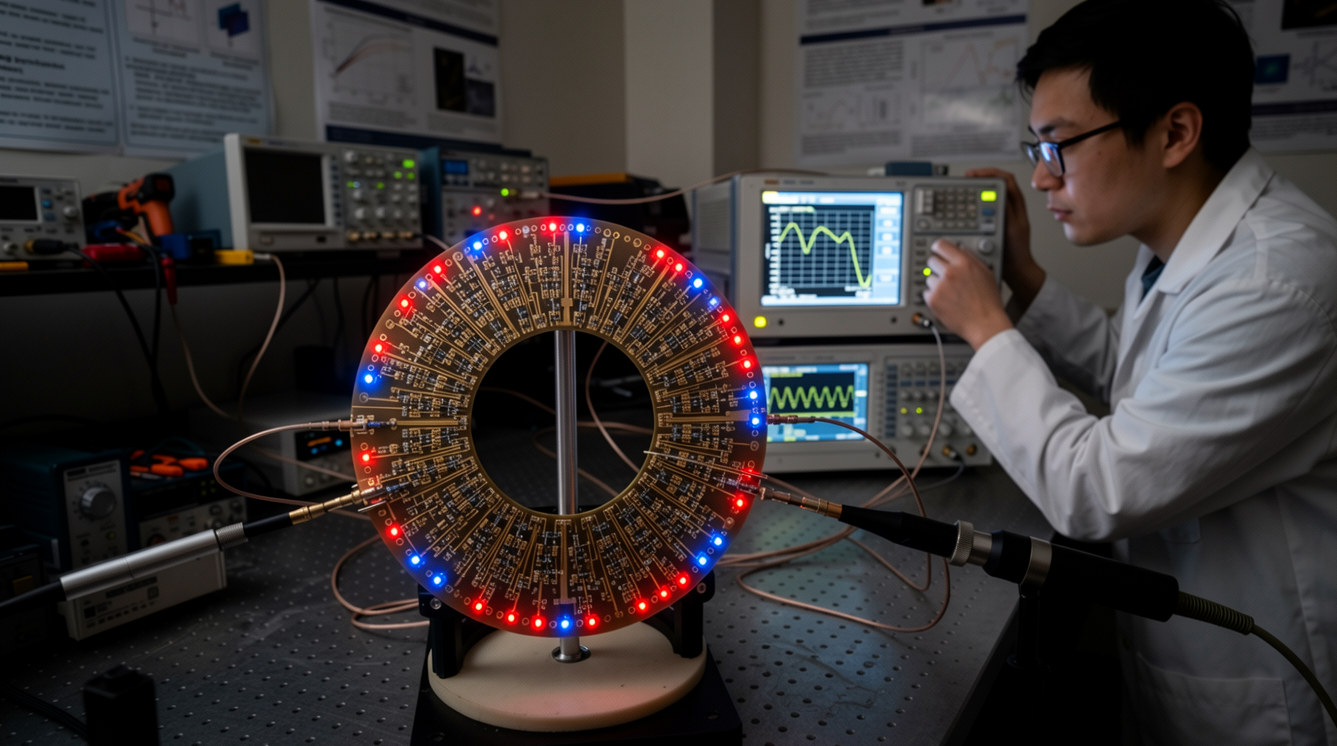
What the CUNY team built is not a spinning object. It is a ring-shaped network of electronic resonators whose electromagnetic properties are modulated in a precise, carefully timed sequence. The modulation travels around the ring in a pattern that makes any wave interacting with the device behave as though it were encountering something rotating at ultrafast speed. The device itself sits perfectly still. The rotation is synthetic, created by the timing of the modulation rather than by any physical movement.
“Our approach facilitates a new method of wave-matter interaction in which waves with selected rotational properties extract energy from synthetic time-engineered rotation, producing a form of broadband selective amplification,” said Andrea Alù, Distinguished Professor of Physics at the CUNY Graduate Center and the study’s principal investigator.
The term “synthetic” here is not a softening of the result. The electromagnetic waves interacting with the device do not know the difference between the synthetic rotation and the real thing. They respond according to the laws of physics that govern their behavior in a rotating field, and those laws produce the same outcome that Penrose and Zel’dovich predicted: waves with the right rotational characteristics extract energy from the system and emerge stronger than they entered. Waves without those characteristics do not.
What superradiance looks like when you build it
The formal name for the effect the team demonstrated is Floquet rotational superradiance. Superradiance, in this context, refers to the amplification of waves through their interaction with a rotating system. Floquet refers to the mathematical framework that describes systems whose properties change periodically in time, which is precisely what the modulated ring of resonators implements.
When the team sent radio-frequency waves into the device, the result confirmed the theory with precision. Waves carrying the appropriate angular momentum properties were amplified as they traveled through the system. They extracted energy from the synthetic rotation and came out stronger. Waves without those properties were not amplified in the same way. The selective amplification was exactly the signature the Penrose-Zel’dovich mechanism predicts, reproduced not near a black hole but in a laboratory in Manhattan.
“Waves with the appropriate rotational characteristics extracted energy from the system and became amplified, reproducing the essential physics of the Penrose-Zel’dovich process,” said Hady Moussa, a former PhD student at CUNY ASRC and co-lead author of the paper.
The device can simulate rotation that would, in a physical object, correspond to surface speeds exceeding the speed of light. This is not a violation of relativity: the pattern of modulation traveling around the ring is not matter, and patterns of modulation can propagate faster than light without violating any physical law. What matters for the superradiance effect is the effective rotational speed the waves perceive, and the device can make that effective speed as high as needed.
What Penrose’s idea actually says about black holes
The Penrose process was the first mechanism ever proposed for extracting energy from a black hole, and it fundamentally changed how physicists thought about these objects. Before Penrose, black holes were understood primarily as cosmic sink holes: matter and energy fell in, and nothing came out. The ergosphere changed that picture. Because spacetime itself rotates in the ergosphere, objects there are not simply falling into a gravitational well. They are being dragged through a rotating medium. And rotating media, as Zel’dovich later showed, can transfer their rotational energy to waves under the right conditions.
The physical picture is now well understood theoretically. A rotating black hole has a finite reservoir of rotational energy. Every time the Penrose process operates, the black hole loses a small amount of that rotation. Eventually, a black hole that has given up all its rotational energy becomes a non-rotating Schwarzschild black hole, and the ergosphere disappears. The process has a natural endpoint. But the amount of energy potentially available in the rotational reservoir of a large, rapidly spinning black hole is immense by any scale that applies to ordinary engineering.
Astrophysicists have proposed that the Penrose mechanism may play a role in powering some of the most energetic phenomena in the observable universe, including the jets of charged particles that blast outward from the cores of active galaxies at nearly the speed of light. Those jets require an enormous energy source, and the rotational energy of supermassive black holes is one of the most plausible candidates for supplying it. The CUNY experiment does not test this astrophysical hypothesis directly, but it provides, for the first time, an experimental platform with which the underlying physics of the energy extraction process can be studied in a controlled, repeatable setting.
Why the lab version matters despite the astronomical distance
The most immediate practical implication of the team’s work is not in astrophysics at all. The principle of selective amplification based on rotational properties of waves has direct applications in communications engineering, photonics, and quantum information processing.
Antennas and communication systems that need to transmit signals in specific directional patterns, optical systems that need to manipulate light carrying angular momentum, quantum devices that need to process information encoded in the rotational states of photons: all of these could benefit from systems that can selectively amplify waves based on their rotational characteristics. The CUNY device demonstrates that this kind of amplification is physically achievable through synthetic rotation, independently of any astrophysical context.
“The work has implications for advances in fundamental science and in communications, optics and photonics,” said lead author Hadiseh Nasari, a postdoctoral researcher at CUNY ASRC. “This opens up a new platform for exploring various phenomena at the intersection of astrophysics, wave physics, and quantum science.”
The team’s synthetic rotation approach also provides a general tool for studying rotational physics in parameter regimes that are otherwise inaccessible. Many theoretical predictions in quantum field theory, condensed matter physics, and gravitational physics involve systems rotating at extreme speeds. Most of those predictions have never been tested because the physical systems required are either impossible to build or impossible to control. A device that can create effective rotation at arbitrary speeds through temporal modulation of material properties opens many of those predictions to experimental investigation.
The gap between 1969 and 2026
The history of physics is full of long delays between prediction and experimental confirmation. General relativity was confirmed by the bending of starlight in 1919, four years after Einstein proposed it. Gravitational waves were predicted by Einstein in 1916 and directly detected in 2015, 99 years later. The Higgs boson was proposed in 1964 and confirmed at the Large Hadron Collider in 2012. These gaps are not failures of physics but reflections of how hard it is to build the tools that theories demand.
The Penrose-Zel’dovich process was proposed between 1969 and 1971 and remained entirely theoretical for 57 years. What ended the wait was not a conventional experimental approach but a conceptual reframing: instead of asking how to spin something fast enough to test the theory, the CUNY team asked what properties a system would need to create the same effect without spinning. The answer, a carefully modulated ring of electronic resonators, is something that can be built with current technology and operated in a university laboratory.
The astrophysics of black holes remains beyond reach. But the physics that makes black holes remarkable, the ability to transfer rotational energy to waves passing through their vicinity, has now moved from a theoretical prediction about objects millions of light-years away to a confirmed experimental result in a building in New York City.
Source
Hadiseh Nasari, Hady Moussa, Andrea Alù et al. “Observation of Floquet rotational super-radiance.” Nature, July 8, 2026.
DOI: 10.1038/s41586-026-10725-y