Scientists found that sleep and exercise can suppress a blood mutation carried by up to half of people over 80, but only if you have the right gene mutated

Somewhere between 20 and 30 percent of people in their fifties and sixties are walking around with a population of mutant blood stem cells they don’t know about. By age 80, that number climbs past 50 percent. The condition is called clonal hematopoiesis, and it’s increasingly being discovered by accident, an incidental finding on a genetic blood panel ordered for something else entirely. Until now, the advice for someone who got this news has been frustratingly thin: there’s no approved treatment, and doctors mostly just monitor.
A study published in Nature on June 10 by researchers at the Icahn School of Medicine at Mount Sinai found that two of the most basic levers a person has, sleep and exercise, can dramatically suppress this condition and the heart disease it drives. But only for some people. Whether it works depends entirely on which gene is mutated.
What’s actually happening in the blood
Clonal hematopoiesis develops when a blood stem cell acquires a mutation that gives it a competitive edge over its neighbors, allowing its descendants to gradually take over a larger share of the blood system. The most commonly mutated genes are DNMT3A, TET2, JAK2, and TP53. The condition itself doesn’t cause symptoms. What it does is raise the risk of blood cancer and, more relevant to most people who have it, accelerate atherosclerosis, the plaque buildup that drives heart attacks and strokes, independent of cholesterol or blood pressure.
The Mount Sinai team, led by Cameron McAlpine, tested whether lifestyle factors already known to affect general inflammation, sleep quality and exercise, could influence how aggressively these mutant clones expand and how much vascular damage they cause. They worked across two human cohorts and mouse models engineered with each of the four major mutations.
The split that determines whether it works
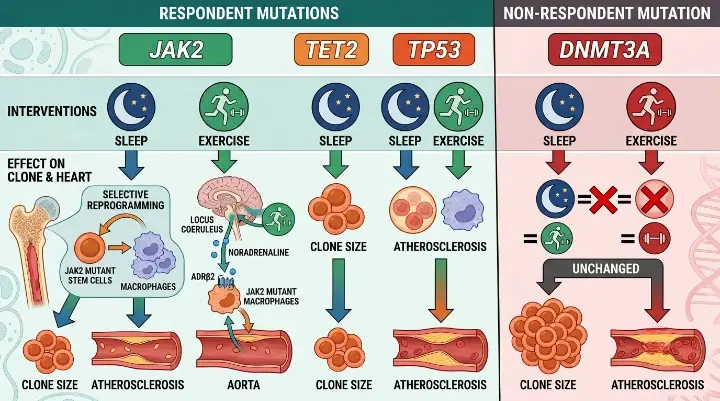
In two separate human datasets, people who got moderate to vigorous physical activity had a lower prevalence of clonal hematopoiesis, but only for the non-DNMT3A mutations. In atherosclerosis-prone mice, uninterrupted sleep and exercise curtailed the expansion of JAK2 and TET2 mutant clones. The same interventions also reduced atherosclerosis driven by JAK2, TET2, and TP53 mutations. For DNMT3A, the single most common clonal hematopoiesis mutation in humans, none of it worked. Sleep and exercise had essentially no effect on either clone size or vascular damage.
This is the detail that changes how this finding should be used. A blanket recommendation to sleep better and exercise more is reasonable health advice for everyone, but for someone who has had a genetic panel come back showing a JAK2 or TET2 mutation, this research suggests those specific behaviors are doing something biologically targeted at the actual disease process. For someone with a DNMT3A mutation, the same advice is still good general health guidance, but it isn’t going to touch the clonal hematopoiesis itself.
How sleep targets the problem
The researchers traced the mechanism down to the cellular level, and it’s specific rather than a generic anti-inflammatory effect. In mice carrying the JAK2 mutation, uninterrupted sleep reprogrammed the mutant blood stem cells themselves, pushing them toward a less proliferative, more metabolically healthy state, by dampening a signaling loop between bone marrow macrophages and the progenitor cells. Critically, this reprogramming was selective: nearby wild-type, non-mutant stem cells living in the same bone marrow were left alone.
In the blood vessels, sleep blunted a specific inflammatory trigger called CLEC4E in JAK2-mutant aortic macrophages specifically, again sparing the genetically normal macrophages sitting right next to them, and this reduced the size of atherosclerotic lesions.
How exercise targets the problem
Exercise worked through an entirely different route. Physical activity activated a population of neurons in the locus coeruleus, a brainstem region involved in the stress and arousal response, which released noradrenaline into circulation. That noradrenaline then acted on a specific receptor, ADRβ2, on the surface of JAK2-mutant aortic macrophages. Exercise preserved the expression of this receptor specifically in the mutant cells, which suppressed their inflammatory behavior and reduced plaque formation, again independent of what was happening to the size of the mutant clone circulating in the blood overall.
In other words, exercise and sleep aren’t simply lowering inflammation across the board. They’re reaching into the blood vessel wall and switching off the specific abnormal cells driving disease, while leaving the surrounding healthy tissue functioning normally.
Why DNMT3A is the exception
The researchers don’t fully resolve why DNMT3A-mutant clones are unresponsive to these interventions while the other three respond so specifically, but the pattern is consistent across both the human and mouse data, which makes it a real biological finding rather than statistical noise. DNMT3A mutations affect DNA methylation machinery broadly, and may produce a different, less inflammation-dependent path to disease than the other three genes, which all converge more directly on innate immune signaling. That mechanistic difference may be exactly why a sleep- and exercise-driven anti-inflammatory effect doesn’t reach it.
What this means right now
This is not a finished clinical recommendation. The human data on exercise and clone prevalence is observational, and the detailed mechanistic work establishing causality was done in mice. A doctor cannot yet tell a patient with JAK2-mutant clonal hematopoiesis that a specific sleep or exercise prescription will measurably shrink their clone or reduce their cardiovascular risk by some quantified amount.
What the study does establish is that clonal hematopoiesis is not a uniform condition that should be managed the same way regardless of which gene is involved, and that two of the most accessible interventions available, sleep quality and physical activity, work through specific, traceable biological pathways that target the mutant cells directly rather than just lowering inflammation in general. For the tens of millions of people over 50 who carry one of these mutations, often without knowing it until a routine blood panel reveals it, the next logical step is knowing which gene is involved before deciding how much weight to put on a sleep and exercise plan as part of managing it.
Sources:
Gerhardt, T., Jacob, W., Gaebel, L., et al.
Mutation-dependent responses to sleep and exercise in clonal haematopoiesis.
Nature, June 10, 2026.
nature.com/articles/s41586-026-10634-0