When one partner sleeps badly, both partners struggle to eat healthily, a study of 204 couples found

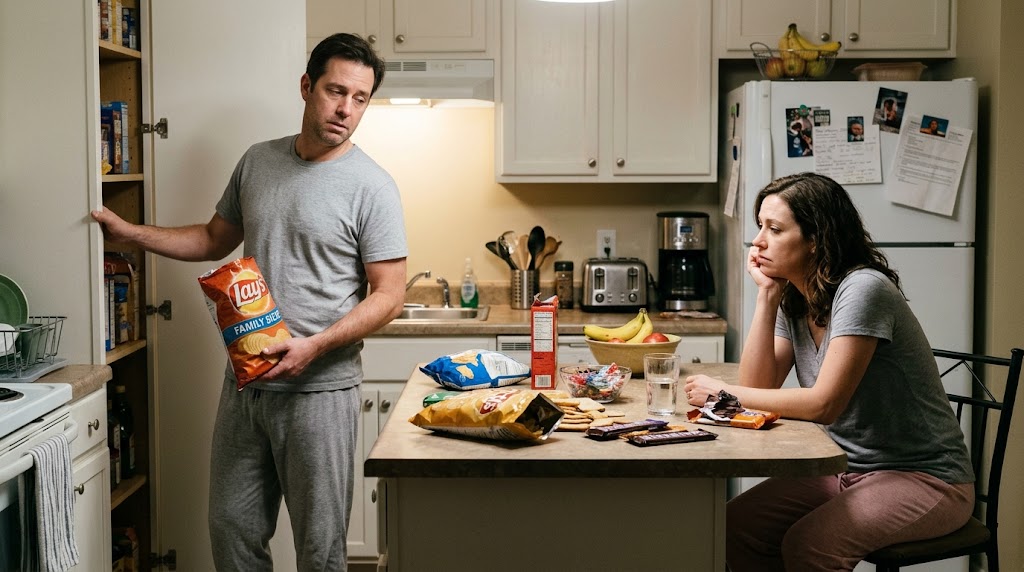
Poor sleep is known to push people toward chips, sweets and other easy calories. Psychologists at Concordia University in Montreal wanted to know whether that effect stays with the person who slept badly, or spreads to whoever they live with. They followed 204 cohabiting couples for three months, with both partners reporting on their sleep and diet at the start, after one month and after three months. For the first two weeks, everyone also kept a daily diary of their efforts to eat well.
It spreads. People who slept poorly reported making less effort to eat well and feeling less confident that they could stick to healthy eating. Their partners, even those who slept well, reported the same drop in effort and confidence.
“People with a sleep-deprived partner were essentially saying they have less confidence in their ability to follow a healthy diet, so they engage in less effort to do so,” said corresponding author Jean-Philippe Gouin, a psychology professor at Concordia.
“This is likely because the sleep-deprived partner was more likely to expose them to highly palatable and calorie-dense food: things like crackers, chips, chocolate or candies,” he said.
The couples were on average 42 years old, and in each couple at least one partner was overweight and trying to improve their diet or exercise. Nearly 96% of participants said they were actively trying to change what they ate. Over the three months, diet quality improved modestly overall, while sleep quality did not change much.
Couples tend to share more than a bed and a fridge. Research on partners keeps finding that habits and health travel between them, from shared music taste to the risk of severe illness.
The second finding is about gender. Women reported healthier diets and stronger efforts to eat well than men, but the effect of one partner’s sleep on the other’s eating was the same regardless of gender.
The researchers suggest treating sleep as a shared concern. Treatments for insomnia, such as cognitive behavioral therapy for insomnia, could be tested as a couple-based approach that might help both partners eat better.
“If we want to make changes that are long-lasting, both partners need to work together to change the home and food environment so that it is easier to maintain healthier habits over time,” Gouin said.
For couples trying to eat better, the practical point is to look at sleep as well as food. Keeping tempting snacks out of easy reach on tired days, and dealing with a partner’s ongoing sleep problems, may help both people more than willpower alone.
There are limits to what this shows. The study is observational and relied on what people reported about their own sleep and eating, so it cannot prove that poor sleep causes unhealthy eating. All couples were Canadian, and every couple included someone already trying to change their diet, which may not reflect couples in general. The study was published in July and funded by the Social Sciences and Humanities Research Council of Canada. The authors declared no conflicts of interest.
Source
Dymarski M, Cohen T, Carbonneau N, Dasgupta K, Gouin JP. “Dyadic associations between sleep quality, diet-related self-regulation, and diet quality in couples.” Annals of Behavioral Medicine, 2026.
DOI: 10.1093/abm/kaag041